Credit Card Payoff Calculator
A credit card payoff calculator is a free online tool that shows you exactly how long it will take to clear your credit card balance. It reveals the true, terrifying cost of paying only the 'Minimum Due' and helps you plan a debt-free exit.
About this tool
A credit card payoff calculator is a free online tool that shows you exactly how long it will take to clear your credit card balance. It reveals the true, terrifying cost of paying only the 'Minimum Due' and helps you plan a debt-free exit.
What if you paid more?
Indian credit cards charge 36-42% annually. Even small extra payments save thousands in interest.
How to use Credit Card Payoff Calculator
- Enter current balance — Type the total outstanding amount on your credit card.
- Enter interest rate — Add the annual interest rate (APR), usually 36-42% in India.
- Enter monthly payment — Type the amount you can pay each month.
- See timeline — View how many months it will take to clear the debt and the total interest paid.
Key features
- Calculates exact months to payoff
- Shows total interest paid
- Reveals the 'minimum due' trap
- Compares different payment scenarios
- Instant results
The Danger of Minimum Due Payments
Credit cards are a double-edged sword. They offer convenience but carry incredibly high interest rates (36-42% annually). When you pay only the minimum due, you are barely covering the interest. The principal remains almost untouched, and the debt can spiral out of control.
How Credit Card Interest Works
Unlike other loans, credit card interest is calculated daily. If you don't pay the full statement balance by the due date, interest is charged from the date of the transaction, not the statement date. This is why credit card debt is so expensive.
Strategies to Pay Off Credit Card Debt
1) Snowball Method: Pay off the smallest balance first for psychological wins. 2) Avalanche Method: Pay off the highest interest rate first to save the most money. 3) Debt Consolidation: Take a personal loan at a lower interest rate to pay off the card. 4) Balance Transfer: Move the balance to a 0% interest card.
The Cost of Carrying a Balance
If you have a ₹1 lakh credit card bill at 36% APR and you pay ₹5,000 per month, it will take you 26 months to clear the debt, and you will pay over ₹28,000 in interest.
Improving Your Credit Score
Paying off your credit card debt is the fastest way to improve your CIBIL score. Keep your credit utilization ratio below 30% of your total credit limit. Never close old credit cards, as the available limit helps your utilization ratio.
Avoiding the Trap
Use credit cards for convenience, not for credit. Always pay the full statement balance every month. If you can't afford to pay cash for something, you probably shouldn't buy it on a credit card unless it's a true emergency.
Pro tips
- Always pay the full statement balance, not just the minimum
- Keep credit utilization below 30%
- Use balance transfer offers carefully
- Set up auto-pay for at least the minimum due to avoid penalties
Common use cases
- Calculating time to pay off credit card debt
- Understanding the cost of minimum due
- Planning a debt payoff strategy
- Comparing balance transfer options
- Improving credit score
Frequently asked questions
What happens if I only pay the minimum due?+
If you only pay the minimum due (usually 5% of the total), it can take years to clear the debt. For a ₹1 Lakh bill, it can take over 10 years, and you will pay more in interest than the original purchase.
How is credit card interest calculated?+
Interest is calculated daily on the outstanding balance, using the Annual Percentage Rate (APR). In India, credit card APRs are typically 36% to 42% per year.
Can I negotiate my credit card debt?+
Yes, if you are facing financial hardship, you can call the bank and request a lower interest rate, a waiver of late fees, or a structured repayment plan.
Is a balance transfer a good idea?+
A balance transfer to a lower-interest card can save you money, but watch out for the transfer fee (usually 2-3%) and the promotional period (often 3-6 months).
What is the grace period?+
The grace period is the time between your statement date and the due date (usually 20-25 days). If you pay the full bill within this period, you pay zero interest.
Does paying the minimum due hurt my credit score?+
Paying the minimum due on time prevents a late payment penalty, but it keeps your credit utilization high. High utilization (above 30%) negatively impacts your CIBIL score.
Can I convert my credit card bill to EMI?+
Yes, most banks offer a 'Convert to EMI' option. The interest rate (usually 12-18%) is much lower than the regular credit card APR.
What is the difference between minimum due and total due?+
Total due is the full amount you owe. Minimum due is a tiny fraction (5%) you must pay to avoid a late fee, but the unpaid balance starts accruing 40% interest immediately.
Need invoicing, billing & inventory?
Try ShopBill Pro — the full business software. Free plan available.
Related tools
📚 Read more about Credit Card
Guides and articles related to this tool.

How to Calculate HRA Exemption in 2026 (Free Calculator)
Complete guide to HRA exemption in 2026 — formula, metro vs non-metro rules, real examples, and mistakes that get people notices.
How to Calculate GST in 2026 (Complete Guide)
Learn how to calculate GST instantly with CGST and SGST split. Free calculator, real examples, and common mistakes to avoid.
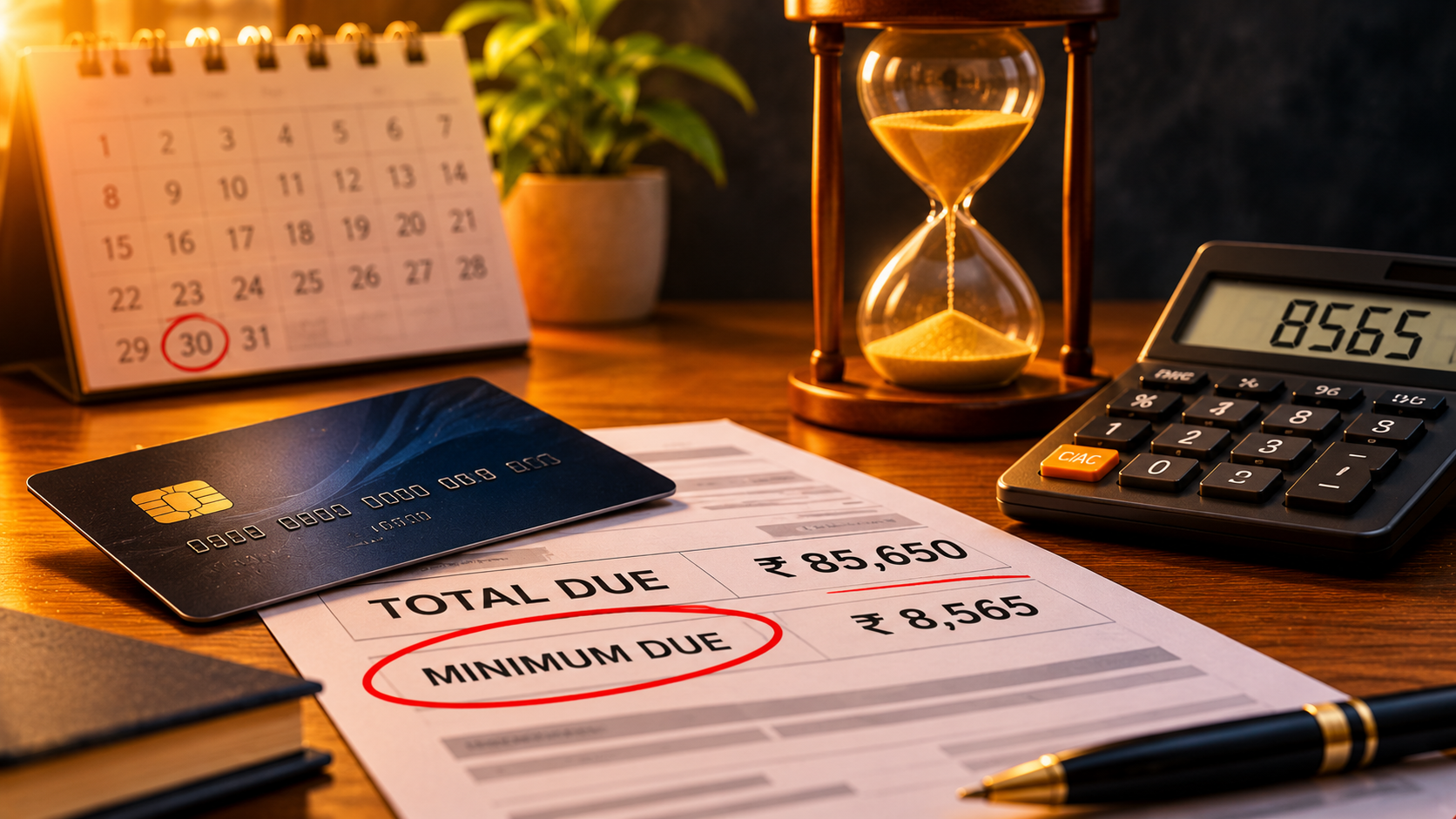
Why Paying the "Minimum Due" on Your Credit Card is a Trap (2026)
If you have a ₹1 Lakh credit card bill at 36% interest, paying only the minimum due will take you over 10 years to clear it. Here is the exact math and how to escape.