Why Paying the "Minimum Due" on Your Credit Card is a Trap (2026)
The ShopBill Pro Tools team builds free browser-based tools for Indian businesses, freelancers, and students. We write about finance, e-commerce, AI, and productivity — with practical, India-specific advice.
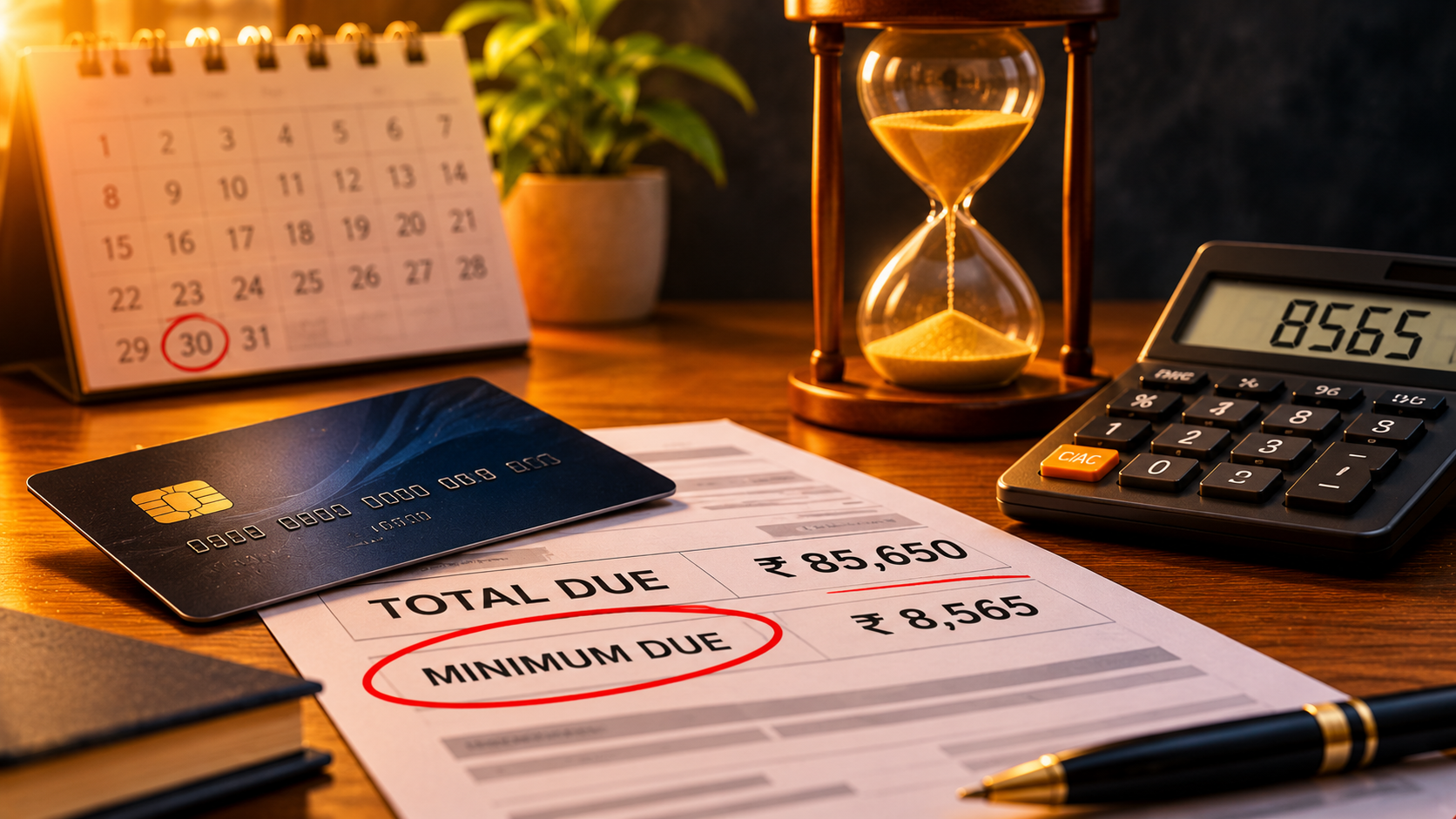
Why Paying the "Minimum Due" on Your Credit Card is a Trap (2026)
Paying only the "Minimum Due" on your credit card is a financial trap. If you have a ₹1 Lakh outstanding bill at a standard 36% annual interest rate, paying just the minimum (usually 5%) will take you over 10 years to clear the debt, and you will pay more than ₹1.8 Lakh in interest alone.
The bank designs the minimum due to keep you in debt for as long as possible while keeping your account technically "active." To see exactly how long your debt will last, use our Credit Card Payoff Calculator.
Here is the honest breakdown of how the minimum due trap works, the exact math behind it, and how to pay off your card without losing your mind.
Total Due vs. Minimum Due: What's the Difference?
Every month, your credit card statement shows two numbers:
- Total Amount Due: The full amount you owe for that billing cycle.
- Minimum Amount Due (MAD): The absolute smallest amount you must pay to avoid late fees and a penalty on your credit score. It is usually 5% of your total outstanding balance.
The Bank's Secret: The bank does not want you to pay the total due. They want you to pay the minimum. Why? Because if you pay only the minimum, the remaining balance rolls over to the next month, and the bank charges interest on it.
And the interest is not calculated from the date of your statement. It is calculated from the date of the original purchase.
Use our Credit Card Payoff Calculator to see how much interest you are currently paying.
The Real Math: ₹1 Lakh Bill at 36% Interest
Credit card interest rates in India are brutal. They range from 36% to 48% per year (3% to 4% per month). Let's look at what happens if you have a ₹1,00,000 bill at 36% annual interest.
| Payment Strategy | Monthly Payment | Time to Clear Debt | Total Interest Paid |
|---|---|---|---|
| Only Minimum Due | Starts at ₹5,000, decreases | Over 10 years (120+ months) | ~₹1,80,000+ |
| Fixed ₹5,000 | ₹5,000 | ~2 years (24 months) | ~₹18,500 |
| Fixed ₹10,000 | ₹10,000 | ~1 year (12 months) | ~₹8,200 |
| Fixed ₹25,000 | ₹25,000 | ~4.5 months | ~₹3,100 |
The takeaway: If you only pay the minimum, you will end up paying almost twice the original amount in interest. And you will be stuck with the debt for a decade.
Use our Credit Card Payoff Calculator to test different monthly payment amounts and find a timeline that works for you.
How Credit Card Interest is Calculated (The Daily Method)
Most people think interest is charged on the remaining balance once a month. That is wrong.
Credit card interest is calculated on a daily reducing balance. Here is the formula the bank uses:
- They take your annual interest rate (e.g., 36%).
- They divide it by 365 to get the daily rate (0.0986%).
- They multiply the daily rate by the number of days the balance was outstanding.
The Trap: If you don't pay the Total Due by the due date, the bank revokes your Grace Period. This means interest is calculated from the date of the transaction, not the date of the statement. So even if you pay 90% of your bill, you are charged interest on the full ₹1 Lakh for the entire month.
The Grace Period: How to Pay Zero Interest
The only way to pay zero interest on a credit card is to use the Grace Period.
The Grace Period is the time between your statement date and your payment due date (usually 20 to 50 days). If you pay the Total Amount Due within this window, the bank charges zero interest on your purchases. You get an interest-free loan for up to 50 days.
The Golden Rule: Treat your credit card like a debit card. Never buy something you don't already have the cash for. Pay the total due every single month. If you carry a balance, the grace period disappears, and you enter the minimum due trap.
5 Ways to Escape the Credit Card Trap
If you are already stuck paying the minimum due, here is how to get out.
- Stop using the card immediately. If you keep swiping, the balance will never go down. Switch to cash or UPI until the debt is cleared.
- Pay a fixed amount, not the minimum. Even if the minimum is ₹5,000, try to pay ₹10,000. The extra amount goes directly toward the principal, reducing the daily interest.
- Use a balance transfer. Many banks offer a 0% interest period (usually 3-6 months) on balance transfers. Transfer your debt to this new card and aggressively pay it down before the interest kicks back in.
- Take a personal loan. Personal loans have much lower interest rates (10-15%) than credit cards. Take a personal loan to pay off the credit card, then pay off the loan.
- Negotiate with the bank. If you are struggling, call the bank and ask to convert your outstanding balance into an EMI. They will usually offer a lower interest rate (around 15-18%) for a fixed tenure.
Use our Credit Card Payoff Calculator to calculate exactly how much you need to pay each month to clear your debt in 6, 12, or 24 months.
Frequently Asked Questions
What happens if I pay only the minimum due?
You will avoid late fees and protect your credit score, but the remaining balance will roll over and attract an interest rate of 36% to 48% per year.
Is the minimum due calculated on the total bill?
Yes, it is usually 5% of your total outstanding balance, plus any past due amounts and interest charges.
How is credit card interest calculated?
Interest is calculated on a daily reducing balance basis from the date of the transaction. If you don't pay the full due, you lose the grace period and are charged interest for the whole month.
Can I convert my credit card bill into an EMI?
Yes. Most banks offer a "convert to EMI" option on your statement, which charges a lower interest rate (15-18%) for a fixed tenure.
What is the grace period on a credit card?
The period between your statement date and the due date (usually 20-50 days). If you pay the total due within this period, no interest is charged.
The Bottom Line
I'm a hotelier. I've seen friends get trapped by the minimum due. They think they are paying the bank, but they are actually just renting the debt.
Pay the full amount. If you can't, pay as much as you can above the minimum. And use our Credit Card Payoff Calculator to see the real math.
Try Our Free Tools
Everything you need to plan your finances — free, no signup:
- Credit Card Payoff Calculator — See how long your debt will last
- EMI Calculator — Calculate monthly payments
- Personal Loan EMI Calculator — Compare loan options
- Compound Interest Calculator — See the power of compounding against you
All tools work in your browser — no signup, no upload.
Written by Vinay. I run a hotel, build tools in my spare time, and learn something new every day. This article is based on my real experience — not theory.
Need free tools while you read?
120+ free tools for Indian businesses - no signup required.
Related articles

How Much Emergency Fund Do You Actually Need in 2026? (The 6-Month Rule)
If your monthly expenses are ₹30,000, you need an emergency fund of ₹1.8 Lakh. Here is the exact math, where to park the money, and how to build it fast.

How to Calculate Trip Fuel Cost for Your Next Road Trip in India (2026)
Planning a road trip? A 600km trip from Mumbai to Goa can cost ₹4,500 in fuel alone. Here is the exact formula to calculate your fuel and toll costs before you leave.

ChatGPT Wallet: How AI Agents Spending Money Will Change Small Business
OpenAI just gave AI agents the ability to make purchases. Here is how the new ChatGPT Wallet works, the security risks, and what it means for your business billing.