How Much Home Loan Can I Get? Salary Eligibility Guide (2026)
The ShopBill Pro Tools team builds free browser-based tools for Indian businesses, freelancers, and students. We write about finance, e-commerce, AI, and productivity — with practical, India-specific advice.
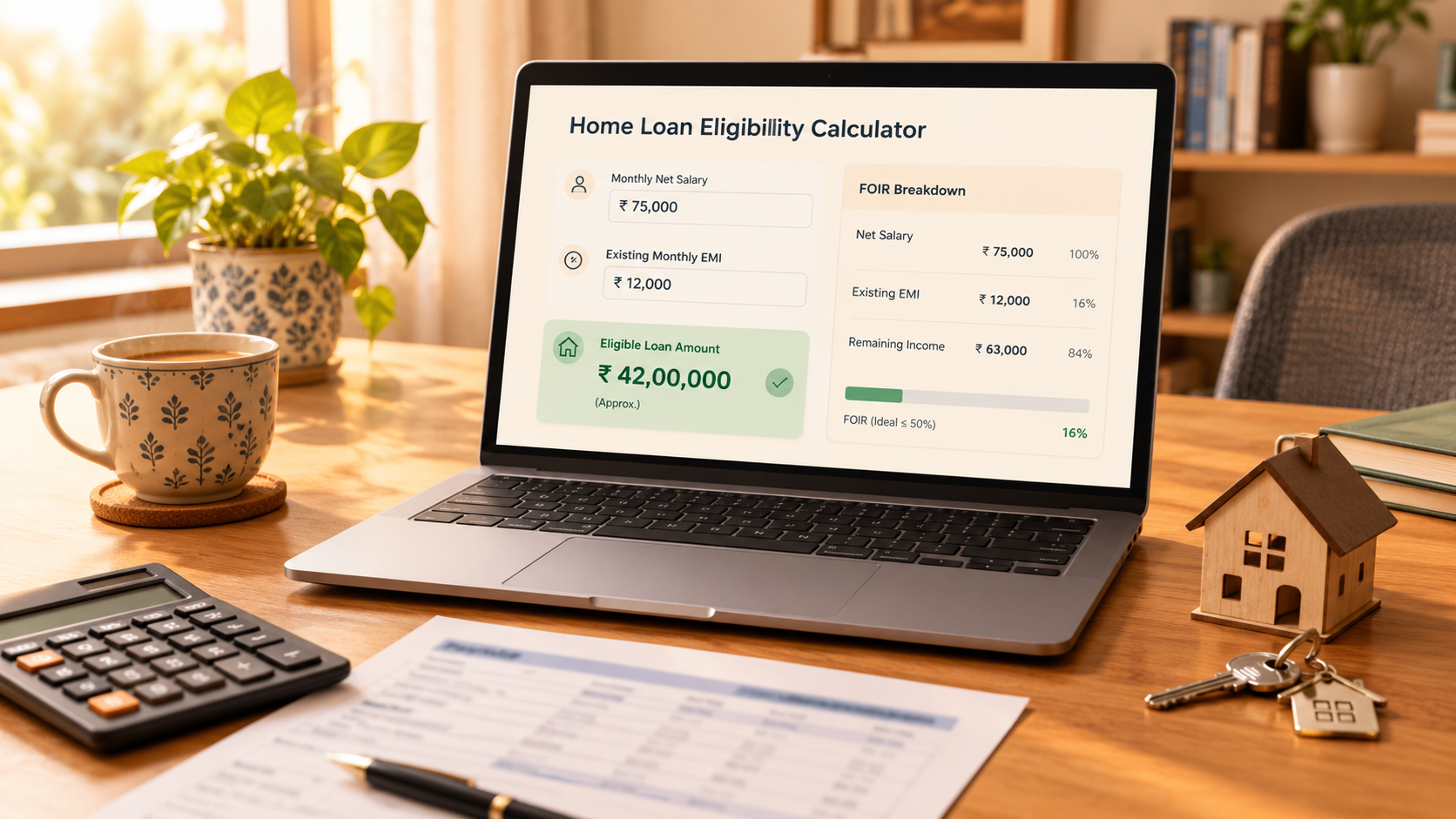
How Much Home Loan Can I Get? Salary Eligibility Guide (2026)
I'm a hotelier. Last month, a guest at my hotel asked me a question I couldn't answer: "Vinay, I earn ₹80,000 a month. How much home loan can I get?"
I gave him the usual answer. "About 60 times your salary. So ₹48 lakh."
He came back two weeks later. His bank approved only ₹32 lakh. He was confused. He'd read the same articles I had. He'd used the same calculators.
That conversation taught me something: the "60x salary" rule is a starting point, not the answer. Banks don't just multiply your salary. They run your income through a formula called FOIR, check your existing loans, look at your credit score, and then decide.
This guide breaks down the actual math banks use — so you know what you'll get before you apply.
The Short Answer (And Why It's Misleading)
Most online calculators suggest a home loan of 48 to 60 times your net monthly salary [citation:1][citation:2].
| Monthly Salary | Calculator Estimate |
|---|---|
| ₹50,000 | ₹30 lakh |
| ₹1,00,000 | ₹60 lakh |
| ₹2,00,000 | ₹1.2 crore |
But here's what those calculators don't tell you: these are illustrations, not guarantees [citation:1].
A person earning ₹1 lakh with no existing loans and a 780 credit score might get ₹60 lakh. The same person with a ₹15,000 car EMI and a 680 credit score might get ₹35 lakh. Same salary. Different answer.
What Is FOIR? (The Real Gatekeeper)
FOIR stands for Fixed Obligation to Income Ratio. It's the single most important number banks use to decide your home loan eligibility [citation:2][citation:8].
Simple definition: FOIR measures what percentage of your monthly income is already committed to loan repayments — or would be, if the bank approves your home loan.
The formula:
FOIR = (Existing EMIs + Proposed Home Loan EMI) ÷ Net Monthly Income
Most banks cap FOIR between 40% and 60%, depending on your income level and employment stability [citation:2][citation:20].
How FOIR Actually Works (With Numbers)
Let me show you with a real example.
Scenario 1: No existing loans.
Rahul earns ₹60,000 net per month. He has no car loan, no personal loan, no credit card debt.
| Step | Calculation | Result |
|---|---|---|
| Max total EMI (50% FOIR) | ₹60,000 × 50% | ₹30,000 |
| Existing EMIs | — | ₹0 |
| Available for home loan EMI | ₹30,000 − ₹0 | ₹30,000 |
| Loan at 8.5%, 20 years | EMI ₹30,000 | ~₹35 lakh |
Rahul can get roughly ₹35 lakh [citation:2].
Scenario 2: Same salary, existing car loan.
Rahul's colleague, Priya, also earns ₹60,000. But she has a car loan EMI of ₹8,000.
| Step | Calculation | Result |
|---|---|---|
| Max total EMI (50% FOIR) | ₹60,000 × 50% | ₹30,000 |
| Existing EMIs | Car loan | ₹8,000 |
| Available for home loan EMI | ₹30,000 − ₹8,000 | ₹22,000 |
| Loan at 8.5%, 20 years | EMI ₹22,000 | ~₹25.7 lakh |
Priya gets roughly ₹25.7 lakh [citation:2].
The difference: Same salary. ₹9-10 lakh less eligibility. Just because of a car loan.
Use our Home Loan Eligibility Calculator to see your exact number based on your existing EMIs.
The Bank Multiplier Rule (What Banks Say vs. What They Do)
Banks and housing finance companies often advertise a simple rule: you can get 60 times your monthly salary [citation:1][citation:7].
On paper:
- ₹50,000 salary = ₹30 lakh loan
- ₹1 lakh salary = ₹60 lakh loan
But here's what the multiplier doesn't account for [citation:1][citation:2]:
- Existing EMIs — Every rupee you already pay reduces what's available for a home loan.
- Credit score — A score below 700 can reduce your eligibility or get you rejected.
- Loan tenure — A longer tenure lowers your EMI, which increases the loan amount you can afford.
- Age — Younger borrowers get longer tenures, which means higher eligibility.
- Property value — Banks won't lend more than 75-90% of the property's value, regardless of your income.
The honest take: The multiplier is a marketing number. FOIR is the real calculation.
Home Loan Eligibility by Salary (2026 Estimates)
Here's a realistic table based on FOIR calculations, assuming no existing EMIs and a 20-year tenure at 8.5% interest [citation:2][citation:20].
| Net Monthly Salary | Max EMI (50% FOIR) | Approx. Loan (20 years) |
|---|---|---|
| ₹25,000 | ₹12,500 | ₹14-15 lakh |
| ₹40,000 | ₹20,000 | ₹23-24 lakh |
| ₹50,000 | ₹25,000 | ₹29-30 lakh |
| ₹60,000 | ₹30,000 | ₹35-36 lakh |
| ₹80,000 | ₹40,000 | ₹47-48 lakh |
| ₹1,00,000 | ₹50,000 | ₹59-60 lakh |
| ₹1,50,000 | ₹75,000 | ₹88-90 lakh |
| ₹2,00,000 | ₹1,00,000 | ₹1.18-1.20 crore |
Important: These numbers assume zero existing EMIs. If you have a car loan, personal loan, or credit card debt, subtract those EMIs from the "Max EMI" column before estimating your loan.
Use our EMI Calculator to see exactly what EMI you can afford at different loan amounts.
What Else Banks Check (Besides Salary)
Salary is just the starting point. Here's what actually decides your final number [citation:1][citation:4][citation:8].
1. Credit Score (CIBIL)
A score of 750+ gets you the best rates and highest eligibility. Below 650, you'll struggle. Below 600, most banks will reject you outright.
2. Age and Remaining Working Years
A 28-year-old can get a 30-year tenure. A 50-year-old might max out at 15 years. Longer tenure = lower EMI = higher eligibility.
3. Employment Stability
Two years in the same job? Good. Six months? Banks get nervous. Government employees and large-company employees get more favourable treatment.
4. Property Value (LTV Limits)
Banks won't lend more than:
- 90% of property value for loans up to ₹30 lakh
- 80% for loans between ₹30-75 lakh
- 75% for loans above ₹75 lakh [citation:1]
If you're buying a ₹50 lakh flat, the bank will lend at most ₹40 lakh — even if your salary qualifies you for ₹60 lakh.
5. Co-Applicant Income
Adding a working spouse or family member as co-applicant can significantly increase your combined eligibility [citation:4][citation:8].
How to Increase Your Home Loan Eligibility
If the number you're getting is lower than what you need, here's what actually works [citation:4][citation:20].
1. Clear existing EMIs before applying.
Paying off a ₹8,000 car loan EMI can increase your home loan eligibility by ₹9-10 lakh. That's the single highest-impact move.
2. Add a co-applicant.
A working spouse with a clean credit score can boost combined eligibility substantially.
3. Choose a longer tenure.
A 30-year tenure lowers your EMI, which increases the loan amount you qualify for. You'll pay more interest overall, but you'll get the home you need.
4. Improve your credit score.
Pay bills on time. Keep credit card utilisation below 30%. Don't apply for multiple loans at once. A 750+ score opens doors.
5. Make a larger down payment.
If you can pay 25-30% of the property value upfront, you need a smaller loan — which is easier to qualify for.
Use our Home Loan Eligibility Calculator to test different scenarios. It updates instantly as you adjust your salary, existing EMIs, and tenure.
Frequently Asked Questions
How much home loan can I get on a ₹50,000 salary?
With no existing EMIs and a 20-year tenure, approximately ₹29-30 lakh. With an existing ₹10,000 EMI, approximately ₹16-17 lakh [citation:5].
Is the 60x salary rule accurate?
No. It's an illustration, not a guarantee. Banks use FOIR, credit score, age, and property value to decide the actual amount [citation:1].
What is FOIR in home loan?
Fixed Obligation to Income Ratio. It measures what percentage of your income goes to loan EMIs. Most banks cap it at 40-60% [citation:2].
Can I get a home loan with a low credit score?
It's harder. A score below 650 reduces eligibility. Below 600, most banks reject. Improve your score before applying.
How much home loan can I get on a ₹1 lakh salary?
With no existing EMIs, approximately ₹59-60 lakh. With a ₹15,000 car EMI, approximately ₹42-43 lakh.
Does adding a co-applicant increase eligibility?
Yes. A working spouse or family member with a clean credit history can significantly boost your combined loan amount [citation:4].
What is the maximum home loan I can get?
There's no fixed maximum, but LTV limits mean banks won't lend more than 75-90% of the property value. Your income and FOIR determine the rest.
The Bottom Line
I'm not a loan officer. I'm a hotelier who watched a guest get surprised by his bank's offer.
Here's what I learned from that conversation: don't trust the multiplier. Trust FOIR.
Calculate your FOIR. Subtract your existing EMIs. Check your credit score. Then use a calculator to see the real number.
And remember: just because a bank approves you for a certain amount doesn't mean you should borrow it. Borrow what you can comfortably repay — not what you're eligible for.
Try Our Free Tools
Everything you need to plan your home loan — free, no signup:
- Home Loan Eligibility Calculator — Exact eligibility based on FOIR
- EMI Calculator — Monthly payment for any loan amount
- Income Tax Calculator — Tax benefits on home loan interest
- Compound Interest Calculator — See the true cost of borrowing
All tools work in your browser — no signup, no upload.
Written by Vinay. I run a hotel, build tools in my spare time, and learn something new every day. This article is based on my real experience — not theory.
Need free tools while you read?
120+ free tools for Indian businesses - no signup required.
Related articles

Flat vs Reducing Interest Rate: Why Car Dealers Trick You (2026)
A 10% flat interest rate is actually an 17.3% reducing rate. Learn how car dealers use the flat rate trick to hide the true cost of your loan and how to calculate it.

XIRR vs CAGR: The Only Way to Measure SIP Returns Accurately
Why does your mutual fund app show a different return than your calculation? Because you are using CAGR for a SIP. Here is why XIRR is the only accurate metric.

Home Loan Eligibility for Self-Employed in India (2026 Guide)
Self-employed professionals often struggle to get home loans due to ITR-based income calculation. Here is how banks assess business income, FOIR, and eligibility.