Home Loan Eligibility Calculator
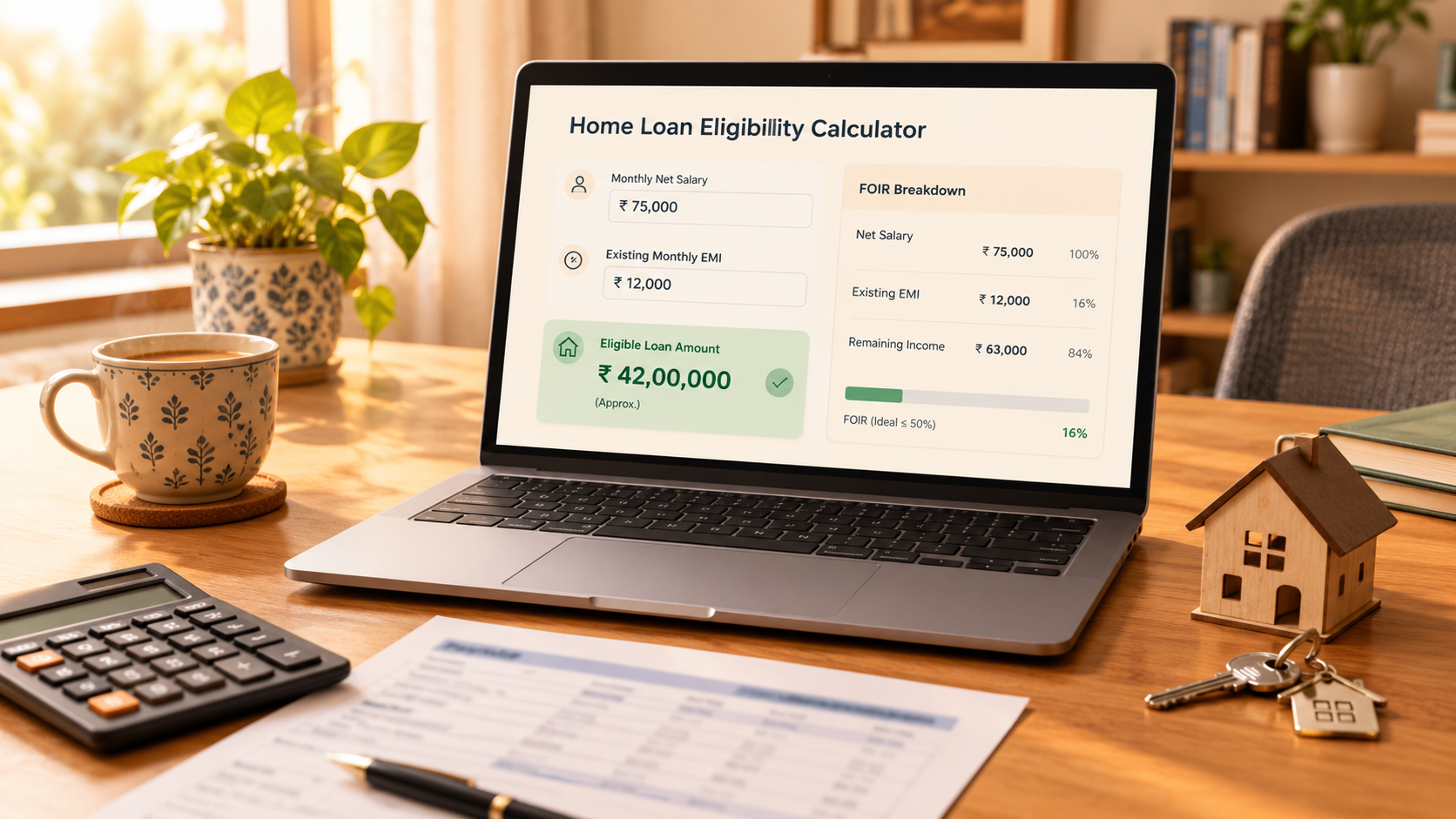
A home loan eligibility calculator is a free online tool that calculates the maximum home loan amount you can get based on your net monthly salary, existing EMIs, age, and the bank's FOIR (Fixed Obligation to Income Ratio).
About this tool
A home loan eligibility calculator is a free online tool that calculates the maximum home loan amount you can get based on your net monthly salary, existing EMIs, age, and the bank's FOIR (Fixed Obligation to Income Ratio).
Most banks use 40-50% FOIR. Some use 55-60% for high earners.
Your Loan Eligibility by Tenure
Note: Most lenders also require the loan to end before you turn 60-65. Actual eligibility depends on credit score, employment stability, and property value.
Read our full guide: How Much Home Loan Can I Get?
How to use Home Loan Eligibility Calculator
- Enter monthly income — Type your net monthly take-home salary.
- Add existing EMIs — Include any ongoing loan EMIs (car, personal, etc.).
- Set FOIR — Lenders typically use 40-50% FOIR. Choose yours.
- See eligibility — View your maximum loan amount across tenures.
Key features
- FOIR-based eligibility calculation
- Multi-tenure comparison (10, 15, 20, 25 years)
- Age-based tenure limits
- Existing EMI deduction
- Instant results
- Indian rupee formatting
What is Home Loan Eligibility?
Home loan eligibility is the maximum amount a bank will lend you based on your income, age, credit score, and existing debt. Banks calculate it using FOIR — the Fixed Obligation to Income Ratio. They want your total monthly EMIs (including the new home loan) to stay below 40-50% of your monthly income. Higher income + clean credit + no existing loans = higher eligibility.
The FOIR Formula and Salary Multiplier
Banks use two primary methods: 1) FOIR Formula: If you earn ₹1 lakh and have ₹20,000 in existing EMIs, and the bank uses 50% FOIR, your max total EMI is ₹50,000. Subtract existing EMIs: ₹50,000 - ₹20,000 = ₹30,000 available for the home loan EMI. 2) Salary Multiplier Rule: Many banks simply multiply your net salary by 60. So a ₹50,000 salary means up to ₹30 lakh loan. The bank will use whichever calculation results in a lower loan amount to minimize their risk.
What Affects Your Eligibility
1) Monthly income — higher is better. 2) Age — younger buyers get longer tenures (usually max 60-65 at loan maturity). 3) Existing EMIs — these reduce capacity. 4) CIBIL score — above 750 preferred. 5) Employment stability — 2+ years in current job helps. 6) Property value — banks lend only 75-90% of property value. 7) Co-applicant income — adding a spouse's income can boost eligibility by 40-80%.
How to Increase Your Home Loan Eligibility
1) Add a co-applicant (spouse, parent) to combine incomes. 2) Pay off existing loans before applying. 3) Choose a longer tenure (reduces EMI, increases eligibility). 4) Improve your CIBIL score. 5) Show additional income sources (rental, freelance) with documents. 6) Make a bigger down payment — reduces the loan needed. 7) Apply with a bank where you have a salary account.
Home Loan Eligibility by Salary (Approximate)
Here is a rough guide based on a 50% FOIR and 9% interest rate for 20 years. ₹25,000/month salary = up to ₹15L loan. ₹50,000/month = up to ₹30L. ₹75,000/month = up to ₹45L. ₹1,00,000/month = up to ₹60L. ₹1,50,000/month = up to ₹90L. Note: These are maximums with no existing EMIs. If you have a car loan or personal loan, your eligibility will be reduced.
What Documents Do Banks Require?
For salaried applicants: Last 3 months salary slips, 6 months bank statement, Form 16, PAN card, Aadhaar card, and employment proof. For self-employed: 2-3 years ITR, audited financials, business proof, and 12 months bank statement. A clean file with all documents ready can speed up approval and sometimes influence the final loan amount.
Pro tips
- Add a co-applicant to boost eligibility 40-80%
- Clear existing EMIs before applying
- Longer tenure = lower EMI = higher eligibility
- Keep CIBIL above 750 for best rates
Common use cases
- Checking maximum home loan amount
- Planning property budget
- Comparing eligibility across banks
- Checking impact of existing EMIs
- Planning co-applicant strategy
Frequently asked questions
How much home loan can I get on a ₹50,000 salary?+
Typically ₹30-50 lakh depending on tenure, FOIR, and existing EMIs. A 30-year-old with no existing loans could get up to ₹35L for 20 years at 9% interest.
What is the salary multiplier rule for home loans?+
Banks often use a multiplier of 60x your net monthly salary. So if you earn ₹50,000/month, the maximum loan might be up to ₹30 lakh. However, FOIR and age limits override this rule.
What is FOIR?+
FOIR (Fixed Obligation to Income Ratio) is the percentage of monthly income lenders allow for EMIs. Typically 40-50%. If you earn ₹1L and have a 50% FOIR, your total EMIs (existing + new) cannot exceed ₹50,000.
Does age affect eligibility?+
Yes — most lenders require the loan to end before you turn 60-65. So a 40-year-old might get only 20-25 years max. A 55-year-old might get only 10 years.
Do existing EMIs reduce eligibility?+
Yes — existing EMIs are subtracted from your FOIR capacity. If you have a ₹10,000 car loan EMI, that directly reduces your home loan eligibility.
Is CIBIL score important?+
Yes — a score above 750 gets you the best rates and maximum eligibility. A score below 650 may result in rejection or lower amounts.
Can I add a co-applicant to increase eligibility?+
Yes. Adding a spouse or parent as a co-applicant combines both incomes, potentially increasing your home loan eligibility by 40-80%.
How is home loan eligibility calculated manually?+
Formula: (Net Monthly Income × FOIR) - Existing EMIs = Maximum EMI. Then use the EMI formula backwards to find the loan amount for your chosen tenure and interest rate.
Need invoicing, billing & inventory?
Try ShopBill Pro — the full business software. Free plan available.
Related tools
📚 Read more about Home Loan
Guides and articles related to this tool.
How Much Home Loan Can I Get? Salary Eligibility Guide (2026)
A ₹1 lakh salary does not mean a ₹60 lakh loan. I break down FOIR, the bank multiplier, and the real math banks use to decide your home loan eligibility.

How to Calculate HRA Exemption in 2026 (Free Calculator)
Complete guide to HRA exemption in 2026 — formula, metro vs non-metro rules, real examples, and mistakes that get people notices.
How to Calculate GST in 2026 (Complete Guide)
Learn how to calculate GST instantly with CGST and SGST split. Free calculator, real examples, and common mistakes to avoid.