Capital Gains Tax on Property Sale in India (2026 Guide)
The ShopBill Pro Tools team builds free browser-based tools for Indian businesses, freelancers, and students. We write about finance, e-commerce, AI, and productivity — with practical, India-specific advice.
Capital Gains Tax on Property Sale in India (2026 Guide)
I'm a hotelier. Last year, a friend sold his flat in Mumbai. He was thrilled with the profit. Then his CA called and told him how much tax he owed. He hadn't planned for it.
The problem wasn't that he owed tax. It was that he didn't understand how the tax worked. He'd heard "12.5%" and assumed that was it. He didn't know about indexation, Section 54 exemptions, or the Capital Gains Account Scheme.
He paid more tax than he needed to. Not because the law was unfair — because he didn't understand it.
This guide covers the 2026 rules for capital gains on property. The rates, the exemptions, and the mistakes that cost people lakhs.
The Short Answer: How Property Sales Are Taxed in 2026
It depends on how long you held the property.
| Holding Period | Tax Type | Rate |
|---|---|---|
| 24 months or less | Short-Term Capital Gains (STCG) | Your slab rate (up to 30%) |
| More than 24 months | Long-Term Capital Gains (LTCG) | 12.5% (without indexation) or 20% (with indexation, if eligible) |
The 24-month rule is the key threshold. Hold property for 24 months and one day, and you qualify for long-term rates. Hold it for 24 months or less, and your profit is taxed like regular income [citation:5][citation:11].
The Big Change: Indexation and the 12.5% Rate
Before July 23, 2024, LTCG on property was taxed at 20% with indexation. Indexation adjusted your purchase price for inflation, reducing your taxable profit.
Then the government changed the rules. For property sold on or after July 23, 2024, the rate dropped to 12.5% without indexation [citation:11].
But there's a grandfathering clause. If you bought the property before July 23, 2024, you have a choice [citation:11][citation:14]:
- Option A: Pay 12.5% without indexation
- Option B: Pay 20% with indexation
You choose whichever results in lower tax.
How to Calculate Your Capital Gains
Here's the formula [citation:5]:
Capital Gain = Sale Price − (Purchase Price + Improvements + Transfer Expenses)
Sale price: The higher of the actual sale value or the stamp duty value.
Purchase price: What you originally paid, including stamp duty and registration.
Improvements: Money spent on permanent improvements (not routine maintenance).
Transfer expenses: Brokerage, legal fees, and other costs directly related to the sale.
Example: Selling a Flat Bought in 2021
Let's say you bought a flat in June 2021 for ₹40 lakh and sold it in December 2026 for ₹80 lakh [citation:8].
Holding period: More than 24 months. Long-term capital gains.
Option A: 12.5% without indexation
| Item | Amount |
|---|---|
| Sale price | ₹80,00,000 |
| Purchase price | ₹40,00,000 |
| Capital gain | ₹40,00,000 |
| Tax @ 12.5% | ₹5,00,000 |
Option B: 20% with indexation (if eligible)
Indexed cost depends on the Cost Inflation Index (CII). For FY2026-27, CII is 384 [citation:14].
Assume indexed cost becomes ₹55 lakh (illustrative).
| Item | Amount |
|---|---|
| Sale price | ₹80,00,000 |
| Indexed cost | ₹55,00,000 |
| Capital gain | ₹25,00,000 |
| Tax @ 20% | ₹5,00,000 |
In this simplified example, both options give ₹5 lakh. In real cases, one option is usually better. Run the numbers for your specific situation.
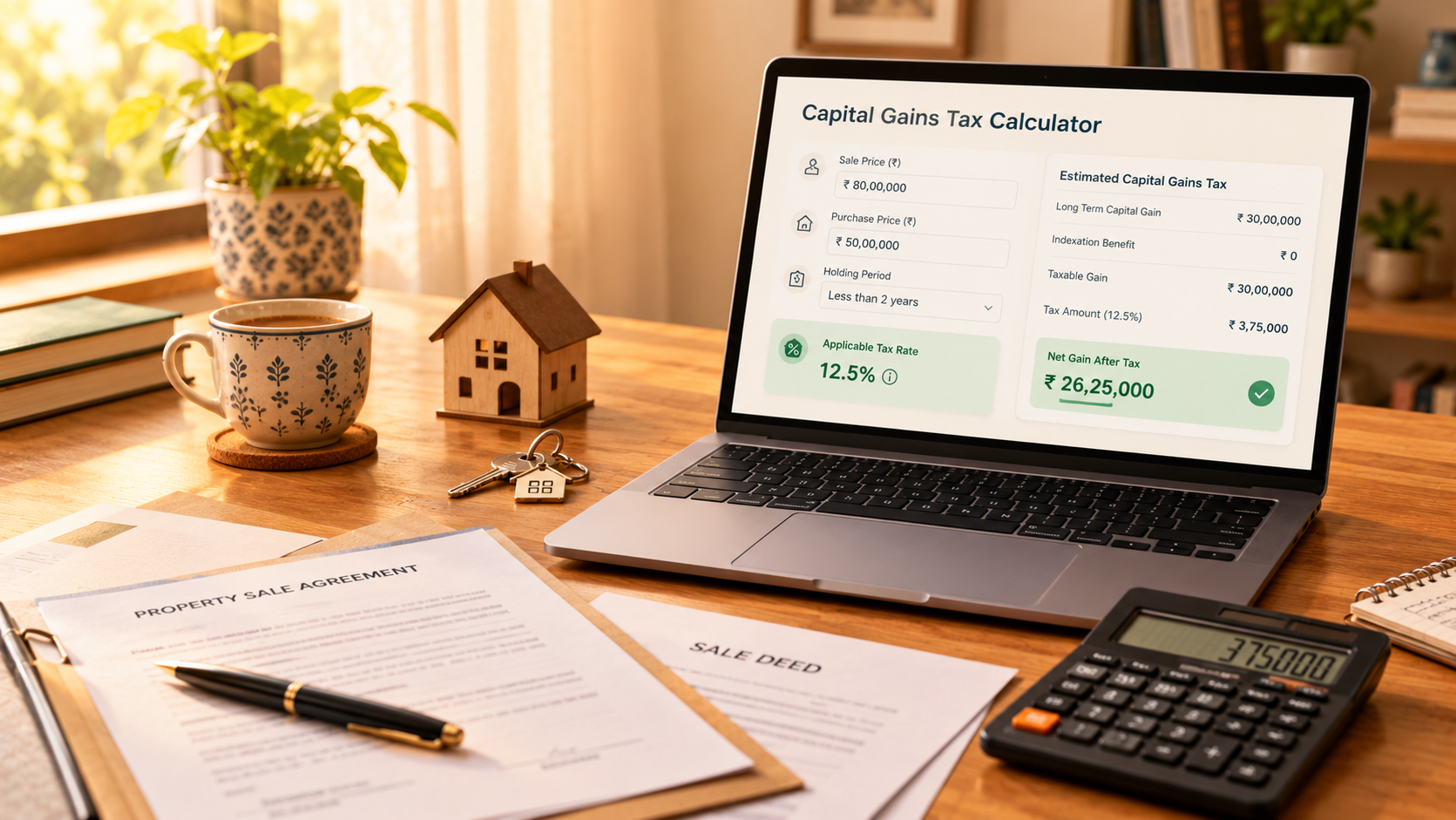
Use our Capital Gains Tax Calculator to compute your exact liability.
Section 54: The Exemption That Can Save You Everything
Section 54 of the Income Tax Act allows you to claim an exemption on LTCG from property sale if you reinvest the gains into another residential property [citation:3].
The rules:
| Requirement | Details |
|---|---|
| Who can claim | Individual or HUF |
| What to buy | One residential house in India (two houses if capital gain ≤ ₹2 crore) |
| When to buy | 1 year before or 2 years after the sale (purchase) or 3 years after (construction) |
| Maximum exemption | Up to ₹10 crore |
How it works:
- If the capital gain is less than or equal to the cost of the new house, the entire gain is exempt.
- If the capital gain is more than the cost of the new house, the difference is taxable.
Example: You have a capital gain of ₹40 lakh. You buy a new house for ₹50 lakh. The entire ₹40 lakh is exempt. If you buy a new house for ₹30 lakh, ₹10 lakh is taxable.
Section 54EC: The Bond Option
If you don't want to buy another house, Section 54EC allows you to invest in specified bonds to claim exemption [citation:5].
The rules:
- Invest up to ₹50 lakh in eligible bonds (NHAI, REC, etc.)
- Must invest within 6 months of the sale
- Bonds have a 5-year lock-in
This is useful if you want to defer the tax without buying another property.
The Capital Gains Account Scheme (CGAS)
What if you sell in December but haven't bought a new house by the ITR due date? You can deposit the unutilised gain into a CGAS account before filing your return [citation:5][citation:8].
The money stays there until you buy the new property. If you don't use it within the specified period, it becomes taxable in the year the period expires.
This is crucial. If you don't deposit the money in CGAS before the due date, you lose the exemption.
The TDS Angle (Don't Ignore This)
If you're buying property, you need to deduct TDS. If you're selling, you need to ensure TDS is deducted and reflected in your Form 26AS [citation:5].
| Rule | Details |
|---|---|
| Section | 194-IA |
| Rate | 1% of sale consideration |
| Threshold | Sale value ≥ ₹50 lakh |
| Who deducts | Buyer |
The mistake sellers make: Treating TDS as the buyer's problem. If TDS isn't deducted or deposited correctly, your tax credit gets delayed. Check your Form 26AS before filing your return.
Use our TDS Calculator to compute TDS on property transactions.
Common Mistakes That Cost Lakhs
1. Not comparing indexation options.
If you bought before July 2024, you have a choice. Run both calculations. One could save you lakhs.
2. Forgetting to deposit in CGAS before the due date.
If you haven't bought a new house by the ITR deadline, deposit the gain in CGAS. Miss this and you lose the exemption.
3. Not keeping improvement records.
Money spent on permanent improvements increases your cost basis. Without receipts, you can't claim them.
4. Using stamp duty value incorrectly.
If your sale price is below the stamp duty value, tax is calculated on the higher value. Don't try to underreport.
5. Missing the 6-month window for 54EC bonds.
If you're going the bond route, invest within 6 months. No extensions.
6. Not checking Form 26AS for TDS credit.
If the buyer didn't deposit TDS correctly, your credit gets stuck. Follow up.
Frequently Asked Questions
What is the capital gains tax rate on property in 2026?
12.5% without indexation for LTCG (held >24 months). If bought before July 23, 2024, you can choose 20% with indexation instead [citation:11].
Can I avoid capital gains tax by buying another house?
Yes, under Section 54. You must buy within 1 year before or 2 years after the sale (or construct within 3 years). Exemption up to ₹10 crore [citation:3].
What is the holding period for long-term capital gains?
More than 24 months [citation:5].
What is the Cost Inflation Index for 2026-27?
384, up from 376 in FY2025-26 [citation:14].
Do I need to pay TDS when selling property?
The buyer deducts 1% TDS if the sale value is ₹50 lakh or more. Ensure it's deposited and reflected in your Form 26AS [citation:5].
Can I claim both Section 54 and 54EC?
You can use both, but the total exemption is capped. Consult a CA for your specific situation.
What if I sell at a loss?
Capital losses can be set off against capital gains. Short-term losses can offset both short-term and long-term gains. Long-term losses can only offset long-term gains [citation:8].
The Bottom Line
Capital gains tax on property isn't complicated once you understand the rules. The problem is that most people learn about it after the sale, when it's too late to plan.
If you're selling property in 2026:
- Check your holding period
- Compare indexation options (if bought before July 2024)
- Consider Section 54 or 54EC
- Deposit in CGAS before the ITR deadline if needed
- Verify TDS credit in Form 26AS
Use our Capital Gains Tax Calculator to run your numbers. It takes 2 minutes and could save you lakhs.
Try Our Free Tools
Everything you need to plan your property sale — free, no signup:
- Capital Gains Tax Calculator — Exact LTCG liability
- Income Tax Calculator — Compare tax regimes
- TDS Calculator — TDS on property and rent
- Home Loan Eligibility Calculator — Plan your next purchase
- Compound Interest Calculator — See long-term growth
All tools work in your browser — no signup, no upload.
Written by Vinay. I run a hotel, build tools in my spare time, and learn something new every day. This article is based on my real experience — not theory.
Need free tools while you read?
120+ free tools for Indian businesses - no signup required.
Related articles

ChatGPT Wallet: How AI Agents Spending Money Will Change Small Business
OpenAI just gave AI agents the ability to make purchases. Here is how the new ChatGPT Wallet works, the security risks, and what it means for your business billing.
Home Loan Amortization Schedule Explained (With Example)
A home loan amortization schedule shows exactly how much of your EMI goes to interest vs principal. In the early years, 80% of your EMI is just interest. Here is how to read it.

Flat vs Reducing Interest Rate: Why Car Dealers Trick You (2026)
A 10% flat interest rate is actually an 17.3% reducing rate. Learn how car dealers use the flat rate trick to hide the true cost of your loan and how to calculate it.