QR Code Menus for Indian Restaurants: A Complete Guide (2026)
The ShopBill Pro Tools team builds free browser-based tools for Indian businesses, freelancers, and students. We write about finance, e-commerce, AI, and productivity — with practical, India-specific advice.
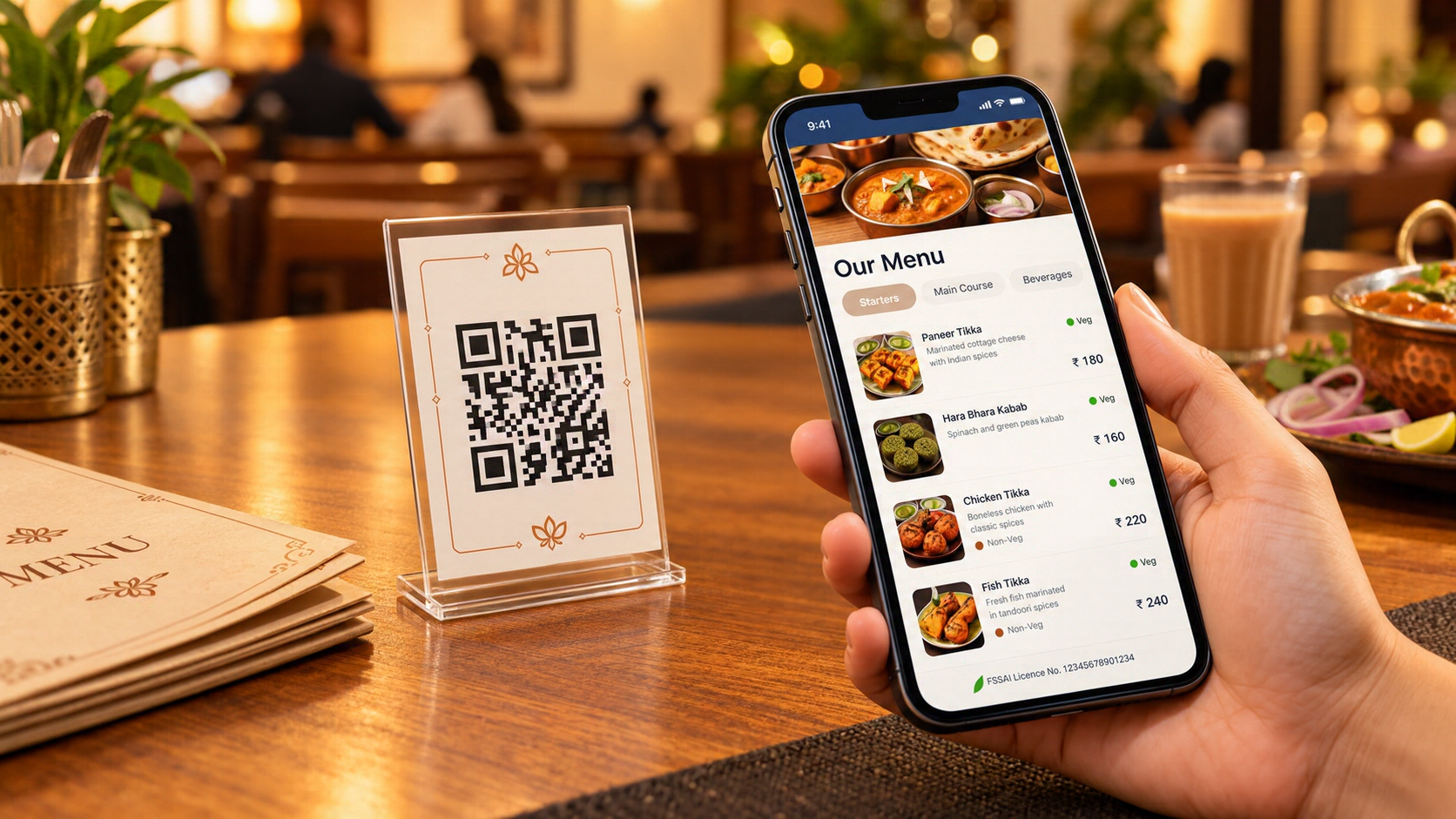
QR Code Menus for Indian Restaurants: A Complete Guide (2026)
I'm a hotelier. When Covid hit, every restaurant in my city rushed to put a QR code on every table. It was practical. No touching menus. No reprinting. No staff handing out laminated cards.
Five years later, half of those QR codes are still there. And half of them shouldn't be.
I've eaten at restaurants where the QR code opened a 35MB PDF that took two minutes to load on a congested network. I've eaten at places where the QR code demanded my phone number and an OTP before I could see the menu. And I've eaten at restaurants where the QR menu was fast, clean, and genuinely better than a paper card.
The difference isn't the technology. It's how it's implemented. And in India, it's also about compliance.
This guide covers the honest truth about QR code menus for Indian restaurants — what works, what fails, the FSSAI rules you can't ignore, and the mistakes I've made myself.
The Data: What 500 Indian Restaurants Actually Said
A 2026 survey of 500 dine-in restaurants across Bengaluru, Mumbai, and Delhi found some uncomfortable truths about QR menus.[reference:0]
| Metric | What Changed |
|---|---|
| Table turn time | 31% faster at high-volume venues during dinner rush |
| Average order value | ₹186 higher per cover, driven mostly by beverages and desserts |
| Guests who still want paper | 12% — and two-thirds of them are over 50 |
The headline numbers look great. But the survey also found that QR menus do not improve every restaurant. They help venues with high volume during peak hours or a menu too complex for a waiter to describe from memory. Everywhere else, the gain is small enough to be lost in noise.[reference:1]
This matches what I've seen. The restaurants where QR menus fail are the ones that adopted them for the wrong reason — not because they solved a problem, but because everyone else was doing it.
The Problem: PDF Menus Are Killing the Experience
This is the single biggest mistake Indian restaurants make.
When Covid hit, most restaurants took their existing menu design file — a PDF or a high-resolution JPEG — uploaded it somewhere, and generated a QR code. The code worked. The PDF didn't.
Why PDF QR menus fail:
| Problem | Why It Hurts |
|---|---|
| File size | A 35MB print PDF over a congested 2Mbps connection takes 140 seconds to download[reference:2] |
| Pinch-zooming | Guests have to zoom and scroll to read anything. It's exhausting.[reference:3] |
| No search | Can't filter by veg/non-veg, price, or spice level |
| No live updates | If you 86 a dish, the PDF still shows it.[reference:4] |
The alternative is a mobile web menu — a responsive page built for the phone. It loads in under two seconds. It's searchable. It shows veg and non-veg symbols clearly. And you can update it instantly without reprinting anything.
A QR code should point to a web menu, not a PDF. If yours points to a PDF, fix it today.
The Other Friction: Login Walls and OTPs
Some QR ordering systems ask diners to enter a 10-digit mobile number and verify an SMS OTP before they can even view the menu.[reference:5]
I've walked out of restaurants because of this. I'm hungry. I want to see the menu. I don't want to create an account, verify my number, and hand over my data before I've ordered a glass of water.
India's consumer protection authority has been clear: businesses should not insist on mobile numbers as a mandatory condition for billing or service.[reference:6] A QR menu that requires an OTP before showing prices is a friction point that drives customers away.
The rule: The menu should load instantly. No login. No OTP. No data collection before ordering. If you need data for loyalty or marketing, collect it after the meal, not before.
Use our QR Code Generator to create a simple code that links directly to your menu page. No tracking, no signup wall, no friction.
FSSAI Rules for Digital Menus in India (2026)
This is the part most restaurants miss. Your QR menu is a customer-facing menu. The same FSSAI labelling rules that apply to printed menus apply to digital ones.[reference:7]
Here's what your QR menu must display.
| Requirement | What It Means |
|---|---|
| FSSAI licence number | Your 14-digit licence or registration number must be visible. The footer of the menu page is standard.[reference:8] |
| Veg / Non-Veg symbols | Green dot in a green square for veg. Brown dot in a brown square for non-veg. Blue triangle for plant-based egg. These are non-negotiable.[reference:9] |
| Allergen disclosure | Eight major allergens should be disclosed. For chain restaurants, this is now a menu-level expectation, not just on request.[reference:10] |
| Calorie labelling (chains) | If you have 10+ outlets across India, calorie counts per serving must be displayed for every item.[reference:11] |
The good news: A QR menu makes compliance easier, not harder. You can update allergen flags or calorie counts in seconds. You can hide items that are temporarily unavailable or out of compliance. You can add disclaimers that won't fit on a printed card.[reference:12]
The bad news: If you're using a static PDF, updating any of this means re-uploading a new file and reprinting nothing — but also losing the ability to make quick changes. A web menu is the only practical way to stay compliant at scale.
When QR Menus Actually Work (And When They Don't)
This is the honest part. QR menus aren't universal. They fit some restaurants and fail in others.
| Restaurant Type | QR Menu Fit | Why |
|---|---|---|
| Cafés and bars | ✅ Strong fit | Second and third rounds are where the money is. Guests order without flagging a server.[reference:13] |
| Breweries and pubs | ✅ Strong fit | Large floors, high volume, repeat rounds.[reference:14] |
| Casual dining, family restaurants | ✅ Good fit | Big tables, mixed orders, lots of small corrections.[reference:15] |
| QSR / Food courts | ✅ Strong fit | Queue avoidance is the whole product.[reference:16] |
| Fine dining | ❌ Poor fit | The server's guidance is the experience. A QR code removes the captain.[reference:17] |
| Small rooms (every table visible) | ❌ Poor fit | The problem QR solves doesn't exist.[reference:18] |
| Menus that need explaining | ❌ Poor fit | Tasting menus, unfamiliar regional dishes. Guests need to ask "what is this like?"[reference:19] |
| Older guest base | ❌ Weak fit | Plan for it. Keep paper menus available.[reference:20] |
The survey found that 12% of guests still ask for a paper menu. Two-thirds of them are over 50. The rest have phones with low battery.[reference:21]
My advice: Keep 5–10 paper menus at the host stand. Don't make it a fight. QR menus are a tool, not a religion.
Real Example: The Hotel Restaurant I Advised
Last year, a restaurant owner near my hotel asked me to look at his QR menu setup.
The problem: He had a beautiful PDF menu. High-resolution. Designed by a professional. But it was 28MB. On a busy Friday night, guests were waiting 30-45 seconds for it to load. Some gave up and asked for paper.
What we did:
- Rebuilt the menu as a lightweight mobile web page
- Added clear veg/non-veg symbols next to every item
- Added the FSSAI licence number in the footer
- Kept a stack of 10 paper menus at the host stand
- Printed the QR code on a small acrylic stand with the instruction: "Scan for menu. No app needed."
The result: The menu loads in under 2 seconds. Guests scan and order without waiting. The owner can update prices and availability instantly. The paper menus are still there for the 12% who want them.
The cost: The web menu software was a few hundred rupees per month. The acrylic stands were a few dozen rupees each. The QR code itself was free.
Use our QR Code Generator to create the code. Point it to your menu page. Print it on a table stand.
The 7-Point Checklist for a QR Menu That Works
Here's what I'd check before putting a QR code on any table.
| # | Check | Why It Matters |
|---|---|---|
| 1 | Points to a web menu, not a PDF | Loads in seconds, searchable, updatable |
| 2 | No login, no OTP | Remove friction. Let guests see prices instantly. |
| 3 | Veg/Non-Veg symbols are FSSAI-compliant | Green dot, brown dot. Not custom icons.[reference:22] |
| 4 | FSSAI licence number is visible | Footer of the menu page. Standard practice.[reference:23] |
| 5 | Allergen information is available | For chain restaurants, menu-level disclosure is expected.[reference:24] |
| 6 | Paper menus are available | 12% of guests will ask. Don't make it a fight.[reference:25] |
| 7 | The QR code is tested | Open it on your own phone. Confirm it loads fast. |
Related Tools You Might Need
- QR Code Generator — Create a code for your menu page
- UPI QR Code Generator — For payments at the table
- WiFi QR Code Generator — Share your network without typing passwords
- Image Compressor — Compress food photos before adding them to the menu
- ShopBill Pro — Billing software with WhatsApp bills and UPI QR
All free. No signup.
Frequently Asked Questions
Is a QR code menu mandatory in India?
No. There is no rule requiring QR menus. But if you use one, FSSAI labelling rules apply to the digital menu just as they do to a printed one.[reference:26]
What FSSAI information must be on a QR menu?
FSSAI licence number, veg/non-veg symbols, allergen disclosure, and calorie labelling for chains with 10+ outlets.[reference:27]
Should my QR code point to a PDF or a web menu?
A web menu. PDFs are heavy, slow to load, and hard to read on a phone. A mobile web menu loads faster and can be updated instantly.[reference:28]
Do QR menus really increase sales?
They can. The 2026 survey found a ₹186 higher average order value per cover, driven mostly by beverages and desserts. But the gain depends on your service model.[reference:29]
Can I keep paper menus too?
Yes. You should. 12% of guests still ask for paper, and two-thirds of them are over 50. Keep 5–10 at the host stand.[reference:30]
Is my restaurant too small for a QR menu?
Possibly. If every table is six steps from the counter and guests can easily catch a server's eye, the problem QR solves doesn't exist. Paper may be simpler.[reference:31]
How much does a QR menu cost?
The QR code is free. The web menu software can cost a few hundred to a few thousand rupees per month. The acrylic table stands are a few dozen rupees each.[reference:32]
Do I need a different QR code for every table?
For a basic menu, one code works for all tables. For table-specific ordering, you need a code per table. Start simple.[reference:33]
The Bottom Line
I'm a hotelier. I've seen QR menus done brilliantly and done terribly. The technology isn't the problem. The implementation is.
If you're going to use a QR menu, do it properly. Point it to a fast web page. Keep FSSAI compliance front and center. Test it on your own phone before you print 50 table stands. And keep paper menus available for the guests who want them.
A QR code is a tool. Use it to solve a real problem, not to follow a trend.
Try Our Free Tools
Everything you need to build a QR menu system — free, no signup:
- QR Code Generator — Create a code for your menu page
- UPI QR Code Generator — Payments at the table
- WiFi QR Code Generator — Share your network
- Image Compressor — Compress food photos
- ShopBill Pro — Billing software for restaurants
All tools work in your browser — no signup, no upload.
Written by Vinay. I run a hotel, build tools in my spare time, and learn something new every day. This article is based on my real experience — not theory.
Need free tools while you read?
120+ free tools for Indian businesses - no signup required.
Related articles

How Much Emergency Fund Do You Actually Need in 2026? (The 6-Month Rule)
If your monthly expenses are ₹30,000, you need an emergency fund of ₹1.8 Lakh. Here is the exact math, where to park the money, and how to build it fast.

How to Calculate Trip Fuel Cost for Your Next Road Trip in India (2026)
Planning a road trip? A 600km trip from Mumbai to Goa can cost ₹4,500 in fuel alone. Here is the exact formula to calculate your fuel and toll costs before you leave.
ChatGPT Wallet: How AI Agents Spending Money Will Change Small Business
OpenAI just gave AI agents the ability to make purchases. Here is how the new ChatGPT Wallet works, the security risks, and what it means for your business billing.