How to Host a Tambola Game at Home (2026 Guide with Voice Calling)
The ShopBill Pro Tools team builds free browser-based tools for Indian businesses, freelancers, and students. We write about finance, e-commerce, AI, and productivity — with practical, India-specific advice.
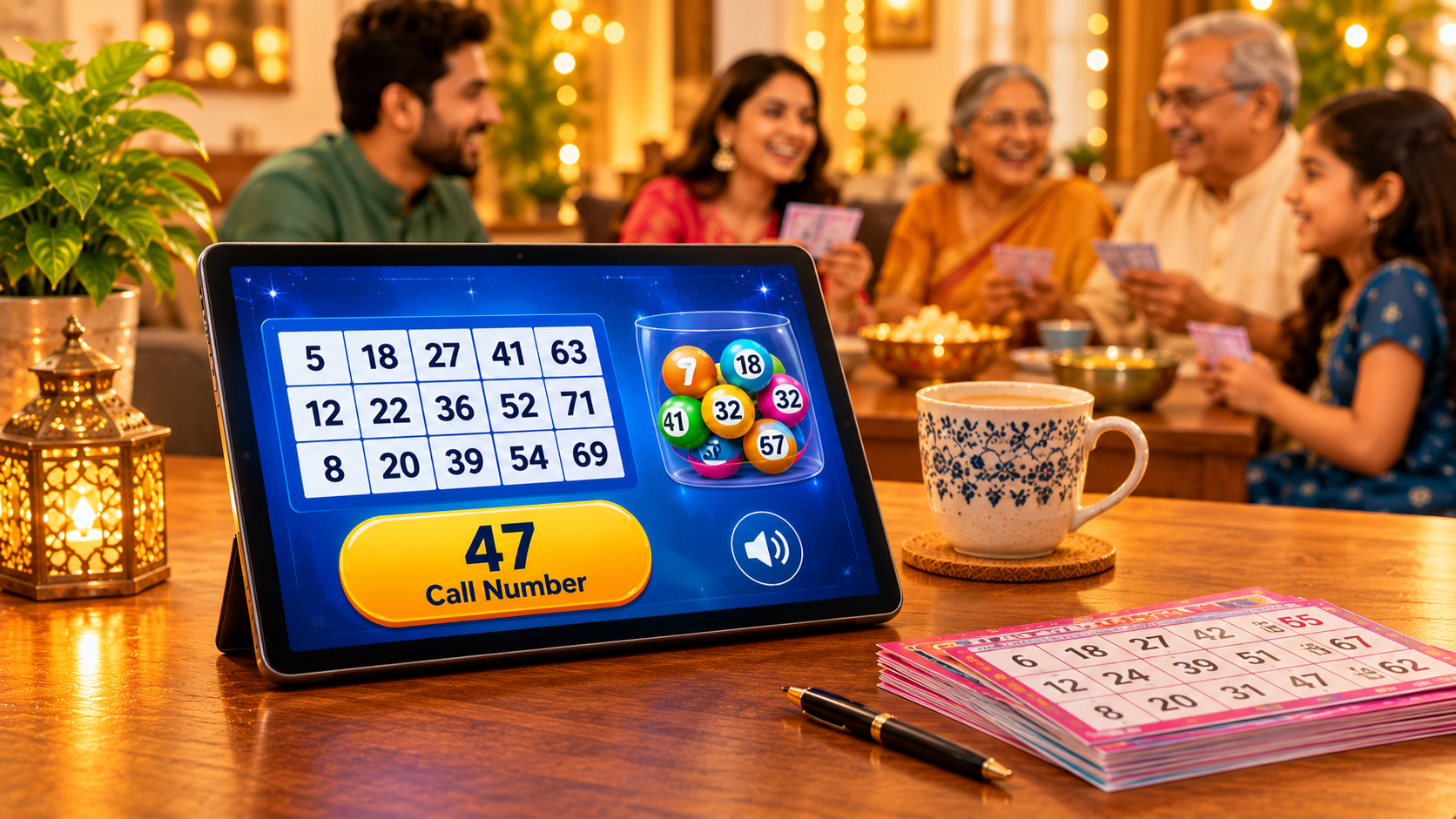
How to Host a Tambola Game at Home (2026 Guide with Voice Calling)
Hosting a Tambola game at home requires just three things: valid tickets, a set of numbers from 1 to 90, and a caller. The easiest way to host in 2026 is to use a digital Tambola number caller with voice announcements (male or female). It removes the need for a loud human caller, ensures every number is random, and displays a board on your TV or phone so everyone can see the numbers called. If you want to host a game this weekend, use our Tambola Number Caller to get started in two minutes.
Here is the complete guide to hosting a flawless Tambola night—from the basic rules to the secret Desi calling phrases that make the game unforgettable.
The Basic Rules of Tambola (What You Must Announce Before Starting)
Before you call the first number, you must explain the rules. Tambola (also called Housie) is simple, but disputes happen when the rules aren't clear.
The Ticket:
- A Tambola ticket is a 3x9 grid.
- It has 3 rows and 9 columns.
- Every ticket contains exactly 15 numbers.
- Each row has exactly 5 numbers.
The Columns:
- Column 1 contains numbers from 1 to 10.
- Column 2 contains numbers from 11 to 20.
- This pattern continues up to Column 9, which contains numbers from 81 to 90.
The Calling:
- Numbers are drawn randomly from 1 to 90.
- Each number is called only once.
- The first person to complete a winning pattern and claim it wins that round.
Use our Tambola Number Caller to ensure every number is random and no number is repeated. It eliminates the risk of a biased or forgetful human caller.[reference:0]
The Winning Patterns (Announce These Before the Game)
You cannot just say "play until someone wins." You must announce which patterns are valid prizes. Here are the standard patterns used in almost every Indian Tambola game.[reference:1][reference:2]
| Pattern Name | What the Player Must Mark | Common Nickname |
|---|---|---|
| Early Five | Any 5 numbers anywhere on the ticket | Jaldi Paanch |
| Top Line | All 5 numbers in the first row | First Line |
| Middle Line | All 5 numbers in the second row | Second Line |
| Bottom Line | All 5 numbers in the third row | Third Line |
| Four Corners | The first and last numbers of the top row, and the first and last numbers of the bottom row | Corners |
| Full House | All 15 numbers on the ticket | Tombola |
Pro Tip: For a small group (under 10 players), play only Early Five, Lines, and Full House. For a large party, include Four Corners and other patterns like the "Star" or "Pyramid" to keep more people engaged.[reference:3]
How to Use a Digital Number Caller (Male/Female Voice Options)
The biggest upgrade in 2026 is the digital caller. Here is why it beats a human with a microphone.
1. It never gets tired. A human caller's voice fades after 45 minutes. A digital caller sounds the same at number 2 and number 87.[reference:4]
2. It has male and female voice options. You can choose the voice that suits your crowd. Some apps even offer Hindi or regional language voices.[reference:5][reference:6]
3. It displays a board. A digital caller usually comes with a visual board. You can mirror it to your TV or share your screen on a video call. Everyone can see which numbers have been called, ending the "was 61 called?" arguments.[reference:7]
4. It handles the pacing. You can set the interval between numbers. For a family group, use 8-10 seconds per number. For an office game, use 4-6 seconds.
Use our Tambola Number Caller to access a digital caller with voice and a visual board. No signup, no app download.
Desi Style Calling: The Secret Language of Tambola
If you want your game to be memorable, you need to use the nicknames. This tradition comes from British bingo halls, where callers invented rhymes to make the game fun and ensure numbers were heard clearly in noisy rooms. The tradition travelled to India and became a beloved part of the game.[reference:8]
Here are the most popular Desi and classic nicknames you can use:
- Number 1: Kelly's Eye[reference:9]
- Number 2: One Little Duck (the 2 looks like a duck)[reference:10]
- Number 4: Knock at the Door[reference:11]
- Number 7: Lucky Seven[reference:12]
- Number 11: Legs Eleven (the two 1s look like legs)[reference:13]
- Number 22: Two Little Ducks[reference:14]
- Number 24: Two and Four (Do Darjan)[reference:15]
- Number 50: Half Century (a cricket reference)[reference:16]
- Number 88: Two Fat Ladies (the curvy 8s)[reference:17]
- Number 90: Top of the Shop[reference:18]
How to use them: Say the nickname first, pause for a second, then say the number. "Two little ducks... twenty-two!" This builds suspense and makes the game a performance, not a mechanical exercise.[reference:19]
Common Hosting Mistakes to Avoid
I've hosted dozens of games at my hotel. Here are the mistakes I see every time.
- Calling too fast. This is the #1 complaint. Players need time to find the number and mark it. If you call too fast, people miss numbers and get frustrated. Stick to 6-8 seconds per number.
- Not displaying the called numbers. If players can't see the board, they will constantly ask "was 47 called?" A digital caller with a board solves this instantly.
- Not announcing the patterns clearly. Write the patterns on a whiteboard or announce them twice before starting. "We are playing Early Five, Top Line, and Full House. No corners today."
- Forgetting to verify claims. When someone shouts "Full House!", do not just hand over the prize. Pause the game, ask them to read out their 15 numbers, and check each one against the called numbers. A digital board makes this a 30-second check.[reference:20]
Frequently Asked Questions
Can I host Tambola without a physical number board?
Yes. A digital Tambola caller with a visual board is actually better than a physical board because it is larger, easier to read, and impossible to lose track of called numbers.
How many numbers are in a Tambola game?
Tambola uses numbers from 1 to 90. Each ticket has 15 numbers, and numbers are called randomly until all prizes are claimed.
What is the best voice option for a Tambola caller?
A clear male or female voice in English or Hindi works best. For a family crowd, a female voice is often preferred for its clarity. For a lively party, a male voice with enthusiasm works well.[reference:21]
Do I need to call all 90 numbers?
No. The game usually ends when someone claims Full House. Depending on the number of players, Full House is often claimed between 60 and 80 calls.[reference:22]
What is the "Two and Four" calling style?
It is a Desi calling style where numbers are broken down into individual digits. For example, 24 is called as "Two and Four" instead of "Twenty-Four." It makes the number easier to hear and adds a local flavour to the game.[reference:23]
The Bottom Line
I'm a hotelier. I've hosted Tambola nights for 40 guests and for 4 guests. The difference between a frustrating game and a legendary one is the caller. A digital caller with voice and a visual board removes all the friction. You focus on the energy; the system handles the numbers.
Use our Tambola Number Caller for your next game. It's free, it works on any phone, and it never misses a number.
Try Our Free Tools
Everything you need for your next game night — free, no signup:
- Tambola Number Caller — Voice calling with male/female options
- Dice Roller — For LCR and board games
- Random Picker Wheel — For other party games
- QR Code Generator — For digital invites
All tools work in your browser — no signup, no upload.
Written by Vinay. I run a hotel, build tools in my spare time, and learn something new every day. This article is based on my real experience — not theory.
Need free tools while you read?
120+ free tools for Indian businesses - no signup required.
Related articles

How Much Emergency Fund Do You Actually Need in 2026? (The 6-Month Rule)
If your monthly expenses are ₹30,000, you need an emergency fund of ₹1.8 Lakh. Here is the exact math, where to park the money, and how to build it fast.

How to Calculate Trip Fuel Cost for Your Next Road Trip in India (2026)
Planning a road trip? A 600km trip from Mumbai to Goa can cost ₹4,500 in fuel alone. Here is the exact formula to calculate your fuel and toll costs before you leave.
ChatGPT Wallet: How AI Agents Spending Money Will Change Small Business
OpenAI just gave AI agents the ability to make purchases. Here is how the new ChatGPT Wallet works, the security risks, and what it means for your business billing.