How to Calculate Salary Hike Percentage (Formula & Free Calculator)
The ShopBill Pro Tools team builds free browser-based tools for Indian businesses, freelancers, and students. We write about finance, e-commerce, AI, and productivity — with practical, India-specific advice.
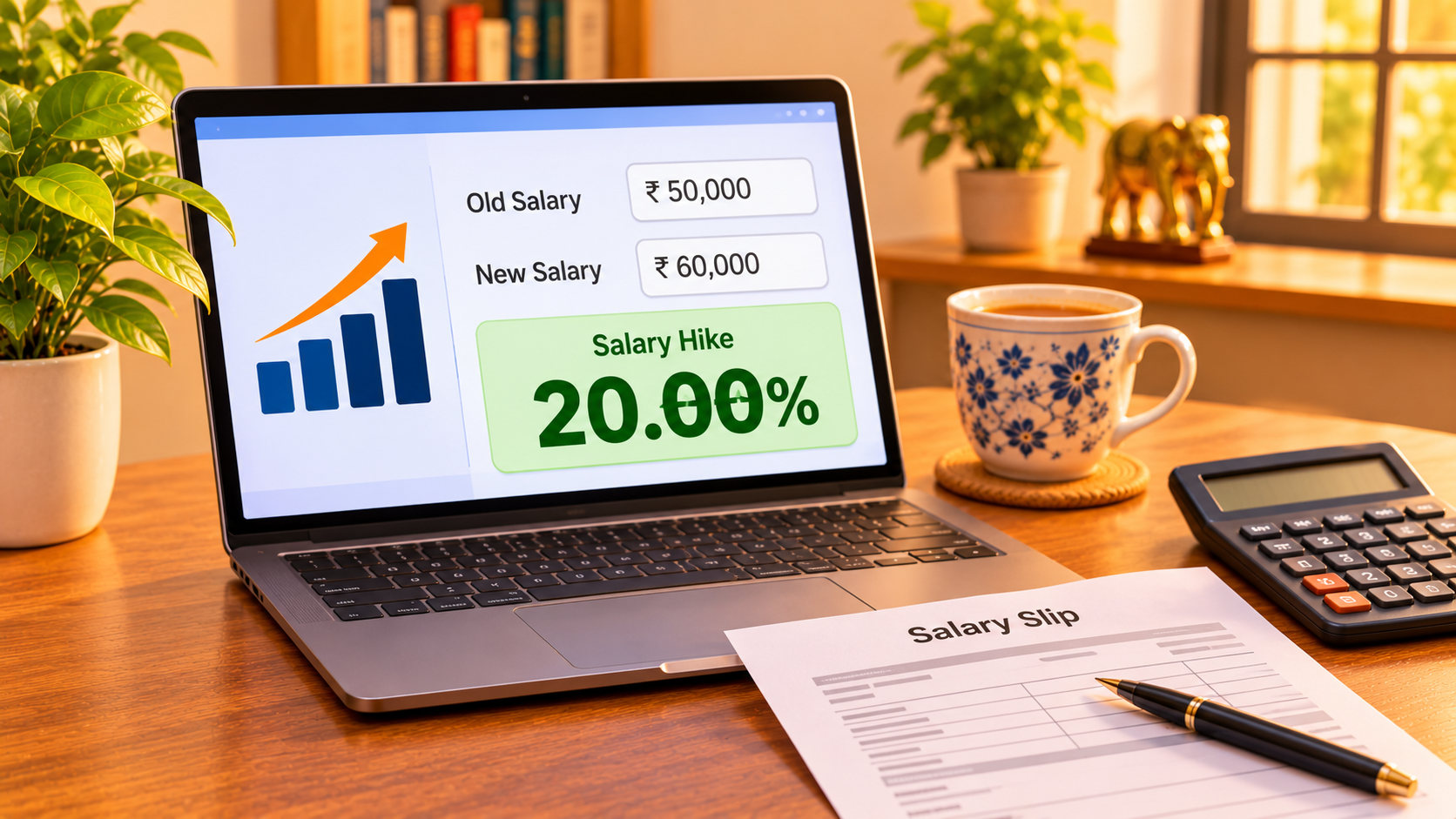
How to Calculate Salary Hike Percentage (Formula & Free Calculator)
I'm a hotelier. Every March, I sit down with my accountant to decide the annual increments for my staff.
One year, an employee came to me and said, "Boss, you gave me a ₹5,000 raise. But my friend got a 10% hike, and he says I only got 8%."
I had to explain to him that a ₹5,000 raise on a ₹50,000 salary is a 10% hike. But a ₹5,000 raise on a ₹62,000 salary is only an 8% hike.
Most people look at the absolute rupee amount. But what matters is the percentage. Whether you are negotiating a new job offer or trying to figure out if your appraisal was fair, you need to know how to calculate your salary hike percentage.
Here is the exact formula, explained simply.
The Basic Formula
Calculating your salary hike percentage is straightforward. You just need two numbers: your old salary and your new salary.
The Formula:
Hike % = ((New Salary − Old Salary) ÷ Old Salary) × 100[reference:14]
Let's break that down:
- Find the difference: Subtract your old salary from your new salary. This is your actual raise in rupees.
- Divide by old salary: Divide that difference by your old salary. This gives you a decimal.
- Multiply by 100: Multiply by 100 to turn it into a percentage.
Use our Salary Hike Calculator to do this instantly without any math.
Example: A Standard Hike
Let's say your current CTC (Cost to Company) is ₹8,00,000 per year. Your company gives you a raise, and your new CTC is ₹9,20,000.
- Old Salary: ₹8,00,000
- New Salary: ₹9,20,000
- Difference: ₹1,20,000
Calculation:
(1,20,000 ÷ 8,00,000) × 100 = 15%
Your salary hike is 15%.
The Reverse Calculation: What Will My New Salary Be?
Sometimes you know the percentage (e.g., HR tells you "you are getting a 10% hike") and you want to know what your new salary will be.
The Formula:
New Salary = Old Salary × (1 + (Hike % ÷ 100)) [reference:15]
Example:
Your current salary is ₹6,00,000. You get a 12% hike.
- 12 ÷ 100 = 0.12
- 1 + 0.12 = 1.12
- ₹6,00,000 × 1.12 = ₹6,72,000 (Your new salary)
The CTC vs. Take-Home Trap
This is the biggest mistake people make.
When you calculate your hike, always use your CTC (Cost to Company), not your monthly take-home salary[reference:16].
Why? Because your CTC includes your basic salary, HRA, special allowances, and the employer's contribution to your PF. Your take-home salary is what is left after taxes and PF deductions.
If you calculate a hike based on take-home, the percentage will be wrong. HR always calculates based on CTC.
Use our HRA Exemption Calculator to understand how much of your new CTC will be tax-free.
What About Variable Pay and Bonuses?
Many companies offer a hike plus a bonus. For example, a 10% hike plus a one-time performance bonus of ₹50,000.
If the bonus is a one-time payment, do not include it in your new CTC when calculating the hike percentage. Only include it if it is guaranteed and part of your fixed annual compensation.
If the bonus is variable (like a sales commission), treat it separately. Calculate your fixed hike percentage on your fixed salary.
Average Salary Hikes in India (2026)
How do you know if your hike is good?
According to a 2026 report by Aon, the average salary increase in India is expected to be around 9.1%. This is significantly higher than the US, where average raises are around 3.4%.
| Country | Average 2026 Salary Hike |
|---|---|
| India | ~9.1% |
| United States | ~3.4% |
If you get a 10% hike, you are slightly above the Indian average. If you get 15%, you are doing excellent. If you get 5%, it's below average (unless your company is struggling or you are switching industries).
Real Example: The Employee Who Thought He Got 10%
Let me go back to the story of my hotel employee.
His Situation:
- Old CTC: ₹60,000 per month (₹7,20,000 per year)
- New CTC: ₹65,000 per month (₹7,80,000 per year)
He thought a ₹5,000 raise meant a "5% hike" (because 5,000 is 5% of 100,000). But that's wrong.
- Difference: ₹60,000 per year
- Old Salary: ₹7,20,000
- Calculation: (60,000 ÷ 7,20,000) × 100 = 8.33%
He actually got an 8.33% hike. Not 10%, and not 5%.
When I showed him the math, he understood. He wasn't angry — he just didn't know the formula.
Use our Salary Hike Calculator to check your own hike. It takes 5 seconds.
Related Tools You Might Need
- Salary Hike Calculator — Calculate your exact hike percentage
- Income Tax Calculator — See how your new salary affects your taxes
- HRA Exemption Calculator — Calculate your HRA tax benefit
- TDS Calculator — Check your TDS liability
- Gratuity Calculator — Plan your long-term benefits
All free. No signup.
Frequently Asked Questions
What is the formula for salary hike percentage?
Hike % = ((New Salary − Old Salary) ÷ Old Salary) × 100. Always use your annual CTC, not monthly take-home pay.
How do I calculate my new salary after a 10% hike?
New Salary = Old Salary × 1.10. For example, ₹5,00,000 × 1.10 = ₹5,50,000.
Should I include bonuses in my hike calculation?
Only if the bonus is guaranteed and part of your fixed CTC. One-time or variable bonuses should not be included.
What is a good salary hike in India?
The average hike in India for 2026 is around 9.1%. A hike of 10-15% is considered good. 15%+ is excellent.
Why is my hike percentage different from what HR told me?
HR calculates the hike on your total CTC. If you are calculating based on your take-home salary, your percentage will be different.
Can I calculate my hike if I am switching jobs?
Yes. Use the same formula. Subtract your old CTC from your new CTC, divide by the old CTC, and multiply by 100.
The Bottom Line
I'm a hotelier. I've seen employees get confused about their hikes because they didn't know the formula.
Don't guess. Don't rely on what someone tells you. Use the formula. Calculate the exact percentage. And use our Salary Hike Calculator to do it instantly.
Knowing your exact hike percentage is the first step to negotiating a better one next year.
Try Our Free Tools
Everything you need to plan your finances — free, no signup:
- Salary Hike Calculator — Exact hike percentage
- Income Tax Calculator — Tax on your new salary
- HRA Exemption Calculator — HRA tax benefits
- TDS Calculator — TDS on salary
- Gratuity Calculator — Long-term benefits
All tools work in your browser — no signup, no upload.
Written by Vinay. I run a hotel, build tools in my spare time, and learn something new every day. This article is based on my real experience — not theory.
Need free tools while you read?
120+ free tools for Indian businesses - no signup required.
Related articles

How Much Emergency Fund Do You Actually Need in 2026? (The 6-Month Rule)
If your monthly expenses are ₹30,000, you need an emergency fund of ₹1.8 Lakh. Here is the exact math, where to park the money, and how to build it fast.

How to Calculate Trip Fuel Cost for Your Next Road Trip in India (2026)
Planning a road trip? A 600km trip from Mumbai to Goa can cost ₹4,500 in fuel alone. Here is the exact formula to calculate your fuel and toll costs before you leave.

ChatGPT Wallet: How AI Agents Spending Money Will Change Small Business
OpenAI just gave AI agents the ability to make purchases. Here is how the new ChatGPT Wallet works, the security risks, and what it means for your business billing.