EAN-13 vs UPC-A: Which Barcode Does Your Indian Product Need? (2026)
The ShopBill Pro Tools team builds free browser-based tools for Indian businesses, freelancers, and students. We write about finance, e-commerce, AI, and productivity — with practical, India-specific advice.
EAN-13 vs UPC-A: Which Barcode Does Your Indian Product Need? (2026)
I'm a hotelier. Last year, a friend who runs a small spice business asked me to help him list his products on Amazon. He'd already printed 500 product labels with a barcode he'd generated from a free website.
Amazon rejected the listing. The barcode wasn't GS1-registered. He'd wasted ₹4,000 on printing labels that were useless. Worse, he'd wasted three weeks.
That's the trap. Barcodes look simple. They're not. And for Indian sellers, the wrong choice doesn't just cost money. It costs time and marketplace access.
This guide covers the only two barcode formats that matter for Indian retail — EAN-13 and UPC-A — and exactly how to get the right one.
The Short Answer: EAN-13 Is Your Default
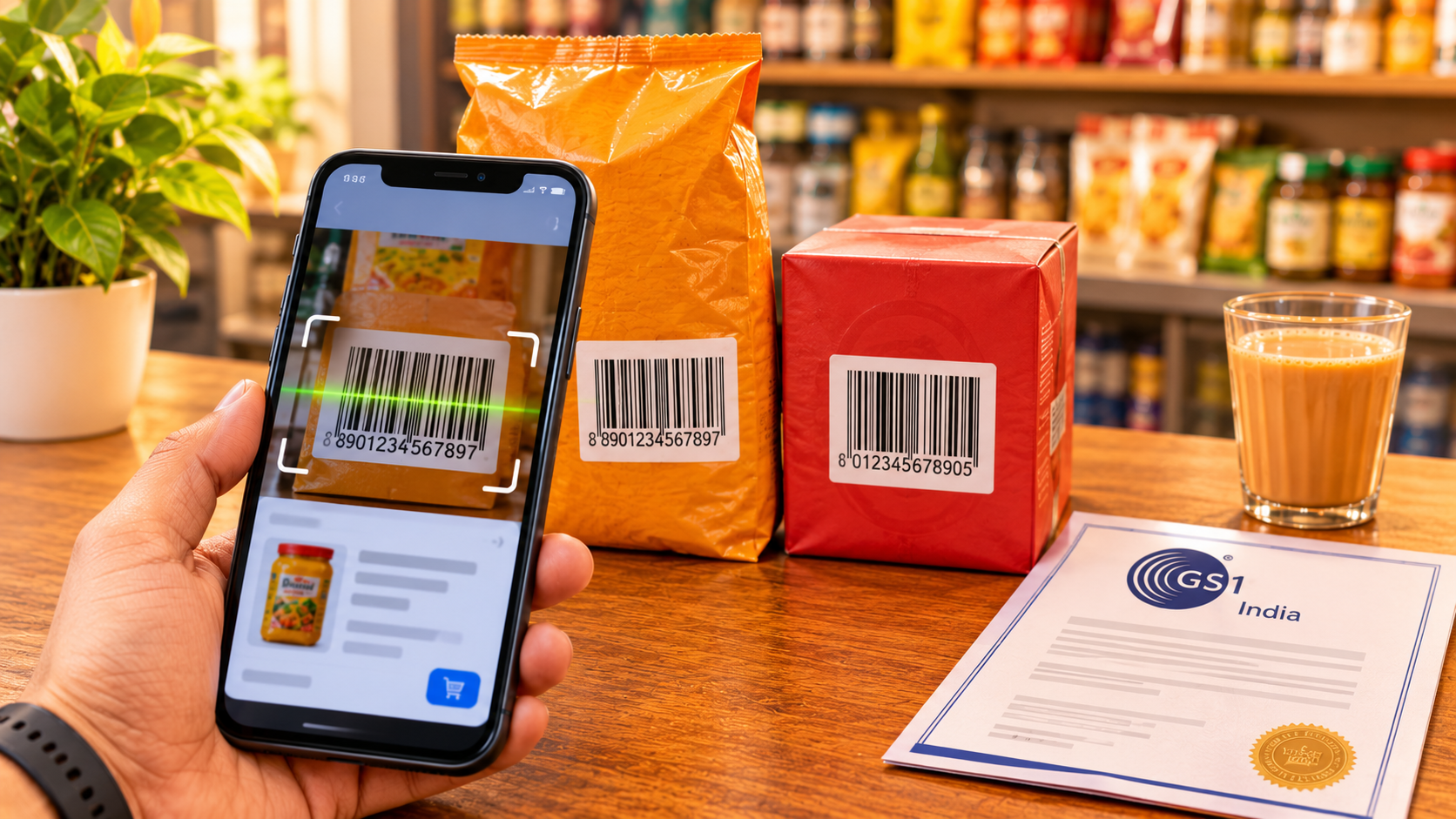
If you're an Indian business selling physical products, EAN-13 is almost always the right choice. It's the 13-digit standard used across India, Europe, and most of Asia, and it's what Amazon India, Flipkart, Meesho, and physical retailers expect at point-of-sale[reference:0].
UPC-A is the 12-digit standard used primarily in the US and Canada. You only need it if you're manufacturing exclusively for the North American market[reference:1].
The practical rule: If you're based in India, generate an EAN-13. If you export to the US, you may need a UPC-A for that specific market. Most modern scanners read both without issue, but marketplaces are strict about what they accept[reference:2].
The Real Difference (It's Not Just the Number of Digits)
The confusion starts with the terminology. Here's how the three main terms relate.
| Term | What It Is | Where It's Used |
|---|---|---|
| GTIN | Global Trade Item Number — the umbrella standard | Worldwide |
| EAN-13 | 13-digit format of GTIN | India, Europe, most of Asia |
| UPC-A | 12-digit format of GTIN | USA, Canada |
GTIN is the category. EAN and UPC are specific formats within that category. Every EAN is a GTIN. Every UPC is a GTIN. But not every GTIN is an EAN or a UPC — there are other formats for cases and pallets[reference:3].
The structural difference:
- EAN-13 includes a country prefix (890 for India), a manufacturer code, a product code, and a check digit[reference:4].
- UPC-A includes a manufacturer code, a product code, and a check digit. It's essentially a subset of EAN-13 — every UPC can be converted to an EAN by adding a leading zero, but not the other way around[reference:5].
EAN-13 vs UPC-A: Side-by-Side Comparison
| Feature | EAN-13 | UPC-A |
|---|---|---|
| Digits | 13 | 12 |
| Primary region | India, Europe, Asia | USA, Canada |
| Indian marketplace acceptance | ✅ Amazon India, Flipkart, Meesho, Blinkit | Limited — accepted only if already registered for US |
| Physical retail in India | ✅ Standard at all POS systems | Rarely used |
| International scalability | ✅ Recognised globally | ❌ North America only |
| GS1 India registration | ✅ Required | Not issued by GS1 India for domestic use |
The verdict for Indian sellers: EAN-13. Every time. Unless you're selling only to the US or Canada, UPC-A offers no advantage[reference:6].
The GS1 Trap: Why Free Barcodes Fail
This is the mistake that costs sellers the most time and money.
You cannot generate a valid EAN-13 from a free barcode website and use it on Amazon, Flipkart, or Meesho.
The barcode number must be issued by GS1 India — the only authorised body in India for EAN and UPC codes. Barcodes bought from resellers or generated randomly often lead to listing rejection, suppression, or account warnings[reference:7].
What happens if you use a free barcode:
| Consequence | What It Means |
|---|---|
| Listing rejection | Amazon/Flipkart won't accept the product ID |
| Listing suppression | Product goes live but is hidden from search |
| Account warnings | Repeated issues can trigger account review |
| Wasted printing costs | Labels become unusable |
The rule: For formal retail or marketplace listings, the barcode number must come from GS1 India. A generated barcode image is fine for internal SKU tracking, but not for a product ID that a marketplace will validate[reference:8].
Use our Barcode Generator to render the barcode image from a GS1-issued number. Do not use it to generate the number itself for marketplace use.
How to Get a GS1-Registered EAN-13 for Your Product
Here's the exact process. It takes a few days, not weeks.
Step 1: Register with GS1 India.
Go to gs1india.org . Choose a licensing package based on how many barcodes you need. Submit PAN, GSTIN, and identity proof[reference:9].
Step 2: Receive your GS1 company prefix.
Once verified, GS1 issues a prefix. For India, the prefix starts with 890[reference:10].
Step 3: Generate your EAN-13 numbers.
Using your GS1 prefix, you can generate unique EAN-13 numbers for each product SKU. Keep a record — marketplaces may ask for documentation[reference:11].
Step 4: Render the barcode image.
Paste your GS1-issued EAN-13 number into our Barcode Generator . Download as SVG for print — it's scalable and what professional printers expect[reference:12]. PNG works for digital use but can pixelate if scaled.
Step 5: Test before printing.
Scan the barcode with at least two different scanner apps. If it scans cleanly on both, it's ready for print. If it doesn't, adjust the size or contrast before ordering 500 labels[reference:13].
What About Code 128 and Code 39?
Not every barcode needs GS1 registration. For internal use — warehouse labels, shelf tags, SKU tracking, shipping slips — you can use formats like Code 128 or Code 39. These don't require a GS1 prefix and can be generated freely[reference:14].
| Use Case | Format | GS1 Required? |
|---|---|---|
| Retail product listing | EAN-13 | ✅ Yes |
| Marketplace product ID | EAN-13 | ✅ Yes |
| Internal SKU tracking | Code 128 | ❌ No |
| Warehouse shelf labels | Code 39 | ❌ No |
| Shipping carton (bulk) | ITF-14 | ✅ Yes (for large retailers) |
The distinction matters: A Code 128 barcode on a warehouse shelf is fine. A Code 128 barcode on a product sold on Amazon is not. Marketplaces validate the format and the registration source.
Common Mistakes to Avoid
I've seen sellers make every one of these. Learn from their mistakes.
1. Generating a random 13-digit number and printing it.
Amazon will reject it. The number must be GS1-registered.[reference:15]
2. Using a barcode bought from a reseller.
Cheap barcodes from third-party websites often lead to listing conflicts. GS1 India is the only authorised source for marketplace-accepted codes.[reference:16]
3. Printing at low DPI.
Barcodes printed at 150 DPI often fail to scan at checkout. Upgrade to 203 DPI or higher.[reference:17]
4. Removing the quiet zones.
The white space on either side of the bars is required for scanning. Don't crop it out to make the barcode smaller.[reference:18]
5. Choosing UPC-A for an India-first product.
Unless you're selling only to the US, EAN-13 is the safer choice. It's accepted everywhere UPC-A is, and more.[reference:19]
6. Not testing before printing.
Scan the barcode with two different apps before ordering labels. A barcode that scans on your phone might fail on a warehouse scanner.[reference:20]
Related Tools You Might Need
- Barcode Generator — Render EAN-13, UPC-A, Code 128, and Code 39 barcodes
- QR Code Generator — For marketing, menus, and reviews
- UPI QR Code Generator — For payments at the counter
- Invoice Generator — GST invoices for your sales
- ShopBill Pro — Billing software with stock tracking and barcode support
All free. No signup.
Frequently Asked Questions
What is the difference between EAN-13 and UPC-A?
EAN-13 is a 13-digit barcode format used in India, Europe, and most of Asia. UPC-A is a 12-digit format used primarily in the US and Canada. EAN-13 is the standard for Indian retail and marketplaces.
Which barcode do I need for Amazon India?
EAN-13, registered with GS1 India. Amazon India does not accept barcodes generated from free websites or bought from resellers. The code must be issued by GS1 India.
Can I generate a barcode for free?
You can render the barcode image for free using our Barcode Generator . But the number must come from GS1 India if you're using it for formal retail or marketplace listings.
What is a GS1 prefix?
A GS1 prefix is a unique number issued to your business by GS1 India. For India, the prefix starts with 890. Your EAN-13 numbers are built using this prefix.
Do I need a barcode for internal SKU tracking?
No. You can use Code 128 or Code 39 for internal labels without GS1 registration. GS1 is only required for retail product IDs.
What happens if I use a fake barcode on Amazon?
Your listing will be rejected or suppressed. Repeated issues can trigger account warnings or suspension.
Can I convert a UPC-A to EAN-13?
Yes, by adding a leading zero. Every UPC-A can be converted to a valid EAN-13. The reverse is not always true.
What format should I download for printing?
SVG. It's scalable, doesn't pixelate, and is what professional printers and design software expect. PNG works for digital use but can pixelate if enlarged.
The Bottom Line
I'm a hotelier. I've watched a friend waste ₹4,000 on useless labels because he didn't know the difference between a real barcode and a generated one.
For Indian sellers, the rule is simple: EAN-13 from GS1 India. Render the image with our free Barcode Generator . Print it at the right size. Test it before you order labels.
A barcode is a small thing. But getting it wrong can keep your product off the shelf entirely.
Try Our Free Tools
Everything you need for product labels and billing — free, no signup:
- Barcode Generator — Render EAN-13, UPC-A, Code 128, and Code 39
- QR Code Generator — For marketing and reviews
- UPI QR Code Generator — Payments at the counter
- Invoice Generator — GST invoices for your sales
- ShopBill Pro — Billing software with stock tracking
All tools work in your browser — no signup, no upload.
Written by Vinay. I run a hotel, build tools in my spare time, and learn something new every day. This article is based on my real experience — not theory.
Need free tools while you read?
120+ free tools for Indian businesses - no signup required.
Related articles

How Much Emergency Fund Do You Actually Need in 2026? (The 6-Month Rule)
If your monthly expenses are ₹30,000, you need an emergency fund of ₹1.8 Lakh. Here is the exact math, where to park the money, and how to build it fast.

How to Calculate Trip Fuel Cost for Your Next Road Trip in India (2026)
Planning a road trip? A 600km trip from Mumbai to Goa can cost ₹4,500 in fuel alone. Here is the exact formula to calculate your fuel and toll costs before you leave.
ChatGPT Wallet: How AI Agents Spending Money Will Change Small Business
OpenAI just gave AI agents the ability to make purchases. Here is how the new ChatGPT Wallet works, the security risks, and what it means for your business billing.